

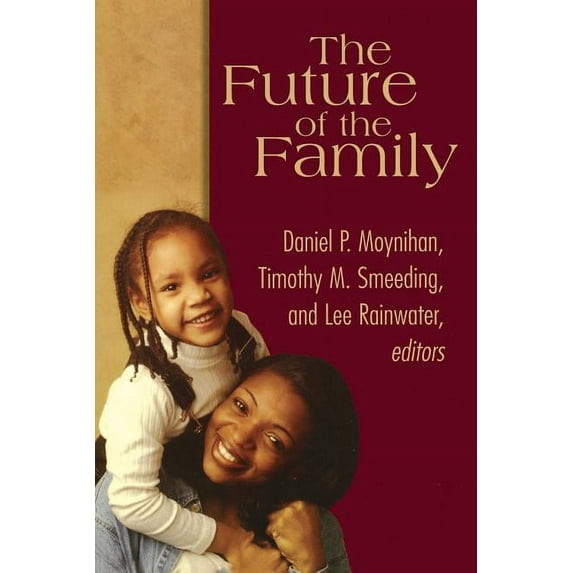
Hero image 0 of The Future of the Family (Paperback), 0 of 1
The Future of the Family (Paperback)
(No ratings yet)
Key item features
High rates of divorce, single-parenthood, and nonmarital cohabitation are forcing Americans to reexamine their definition of family. This evolving social reality requires public policy to evolve as well. The Future of the Family brings together the top scholars of family policy—headlined by editors Lee Rainwater, Tim Smeeding, and, in his last published work, the late Senator Daniel Patrick Moynihan—to take stock of the state of the family in the United States today and address the ways in which public policy affects the family and vice versa. The volume opens with an assessment of new forms of family, discussing how reduced family income and lower parental involvement can disadvantage children who grow up outside of two-parent households. The book then presents three vastly dissimilar recommendations—each representing a different segment of the political spectrum—for how family policy should adapt to these changes. Child psychologist Wade Horn argues the case of political conservatives that healthy two-parent families are the best way to raise children and therefore should be actively promoted by government initiatives. Conversely, economist Nancy Folbre argues that government's role lies not in prescribing family arrangements but rather in recognizing and fostering the importance of caregivers within all families, conventional or otherwise. Will Marshall and Isabel Sawhill borrow policy prescriptions from the left and the right, arguing for more initiatives that demand personal responsibility from parents, as well as for an increase in workplace flexibility and the establishment of universal preschool programs. The book follows with commentary by leading policy analysts Samuel Preston, Frank Furstenberg Jr., and Irwin Garfinkel on the merits of the conservative and liberal arguments. Each suggests that marriage promotion alone is not enough to ensure a happy, healthy, and prosperous future for American children who are caught up in the vortex of family change. They agree that government investments in children, however, can promote superior developmental outcomes and even potentially encourage traditional families by enlarging the pool of "marriageable" individuals for the next generation. No government action can reverse trends in family formation or return America to the historic nuclear family model. But understanding social change is an essential step in fashioning effective policy for today's families. With authoritative insight, The Future of the Family broadens and updates our knowledge of how public policy and demography shape one another.
Specs
- Book formatPaperback
- Fiction/nonfictionNon-Fiction
- GenreNonfiction
- Publication dateJanuary, 2006
- Pages328
- Reading levelGeneral Adult
Current price is USD$36.16
Price when purchased online
- Free shipping
 Free 30-day returns
How do you want your item?
Columbus, 43215
Arrives between May 14 - May 20
|
Sold and shipped by newbookdeals
4.558899844317592 stars out of 5, based on 1927 seller reviews(4.6)1927 seller reviews

Free 30-day returns
About this item
Product details
High rates of divorce, single-parenthood, and nonmarital cohabitation are forcing Americans to reexamine their definition of family. This evolving social reality requires public policy to evolve as well. The Future of the Family brings together the top scholars of family policy--headlined by editors Lee Rainwater, Tim Smeeding, and, in his last published work, the late Senator Daniel Patrick Moynihan--to take stock of the state of the family in the United States today and address the ways in which public policy affects the family and vice versa. The volume opens with an assessment of new forms of family, discussing how reduced family income and lower parental involvement can disadvantage children who grow up outside of two-parent households. The book then presents three vastly dissimilar recommendations--each representing a different segment of the political spectrum--for how family policy should adapt to these changes. Child psychologist Wade Horn argues the case of political conservatives that healthy two-parent families are the best way to raise children and therefore should be actively promoted by government initiatives. Conversely, economist Nancy Folbre argues that government's role lies not in prescribing family arrangements but rather in recognizing and fostering the importance of caregivers within all families, conventional or otherwise. Will Marshall and Isabel Sawhill borrow policy prescriptions from the left and the right, arguing for more initiatives that demand personal responsibility from parents, as well as for an increase in workplace flexibility and the establishment of universal preschool programs. The book follows with commentary by leading policy analysts Samuel Preston, Frank Furstenberg Jr., and Irwin Garfinkel on the merits of the conservative and liberal arguments. Each suggests that marriage promotion alone is not enough to ensure a happy, healthy, and prosperous future for American children who are caught up in the vortex of family change. They agree that government investments in children, however, can promote superior developmental outcomes and even potentially encourage traditional families by enlarging the pool of "marriageable" individuals for the next generation. No government action can reverse trends in family formation or return America to the historic nuclear family model. But understanding social change is an essential step in fashioning effective policy for today's families. With authoritative insight, The Future of the Family broadens and updates our knowledge of how public policy and demography shape one another.
High rates of divorce, single-parenthood, and nonmarital cohabitation are forcing Americans to reexamine their definition of family. This evolving social reality requires public policy to evolve as well. The Future of the Family brings together the top scholars of family policy—headlined by editors Lee Rainwater, Tim Smeeding, and, in his last published work, the late Senator Daniel Patrick Moynihan—to take stock of the state of the family in the United States today and address the ways in which public policy affects the family and vice versa. The volume opens with an assessment of new forms of family, discussing how reduced family income and lower parental involvement can disadvantage children who grow up outside of two-parent households. The book then presents three vastly dissimilar recommendations—each representing a different segment of the political spectrum—for how family policy should adapt to these changes. Child psychologist Wade Horn argues the case of political conservatives that healthy two-parent families are the best way to raise children and therefore should be actively promoted by government initiatives. Conversely, economist Nancy Folbre argues that government's role lies not in prescribing family arrangements but rather in recognizing and fostering the importance of caregivers within all families, conventional or otherwise. Will Marshall and Isabel Sawhill borrow policy prescriptions from the left and the right, arguing for more initiatives that demand personal responsibility from parents, as well as for an increase in workplace flexibility and the establishment of universal preschool programs. The book follows with commentary by leading policy analysts Samuel Preston, Frank Furstenberg Jr., and Irwin Garfinkel on the merits of the conservative and liberal arguments. Each suggests that marriage promotion alone is not enough to ensure a happy, healthy, and prosperous future for American children who are caught up in the vortex of family change. They agree that government investments in children, however, can promote superior developmental outcomes and even potentially encourage traditional families by enlarging the pool of "marriageable" individuals for the next generation. No government action can reverse trends in family formation or return America to the historic nuclear family model. But understanding social change is an essential step in fashioning effective policy for today's families. With authoritative insight, The Future of the Family broadens and updates our knowledge of how public policy and demography shape one another.
info:
We aim to show you accurate product information. Manufacturers, suppliers and others provide what you see here, and we have not verified it.
Specifications
Book format
Paperback
Fiction/nonfiction
Non-Fiction
Genre
Nonfiction
Publication date
January, 2006
Warranty
Warranty information
Please be aware that the warranty terms on items offered for sale by third party Marketplace sellers may differ from those displayed in this section (if any). To confirm warranty terms on an item offered for sale by a third party Marketplace seller, please use the 'Contact seller' feature on the third party Marketplace seller's information page and request the item's warranty terms prior to purchase.
Similar items you might like
Based on what customers bought
Unwrapping the Sacred Bundle: Reflections on the Disciplining of Anthropology, (Paperback) $33.56
 $3356current price $33.56
Unwrapping the Sacred Bundle: Reflections on the Disciplining of Anthropology, (Paperback)
Making Sense of Social Movements, (Paperback) $34.99
 $3499current price $34.99
Making Sense of Social Movements, (Paperback)
Shepperson Series in Nevada History: The Making of Modern Nevada (Paperback) $26.42
 $2642current price $26.42
Shepperson Series in Nevada History: The Making of Modern Nevada (Paperback)
Material Cultures : Why Some Things Matter (Paperback) $33.36
 $3336current price $33.36
Material Cultures : Why Some Things Matter (Paperback)
The Most Beautiful Man in Existence: The Scandalous Life of Alexander Lesassier, (Hardcover) $48.06
 $4806current price $48.06
The Most Beautiful Man in Existence: The Scandalous Life of Alexander Lesassier, (Hardcover)
Sir Francis Chantrey (Paperback) $35.52
 $3552current price $35.52
Sir Francis Chantrey (Paperback)
Understanding Peasant China : Case Studies in the Philosophy of Social Science (Paperback) $34.29
 $3429current price $34.29
Understanding Peasant China : Case Studies in the Philosophy of Social Science (Paperback)
Anecdotes Of Fontainebleau (Paperback) $26.96
 $2696current price $26.96
Anecdotes Of Fontainebleau (Paperback)
History of the Keck Family; 2 (Hardcover) $30.10
 $3010current price $30.10
History of the Keck Family; 2 (Hardcover)
A new and complete System of Universal Geography (Paperback) $38.62
 $3862current price $38.62
A new and complete System of Universal Geography (Paperback)
Andrew D. Urshan: A Theological Biography (Paperback) by Daniel L Segraves $35.40
 $3540current price $35.40
Andrew D. Urshan: A Theological Biography (Paperback) by Daniel L Segraves
Unmarried Couples with Children (Paperback) $41.52
 $4152current price $41.52
Unmarried Couples with Children (Paperback)
The Politics of Pure Science (Paperback) $12.27
 $1227current price $12.27
The Politics of Pure Science (Paperback)
Seeds of the Sixties, (Paperback) $40.94
 $4094current price $40.94
Seeds of the Sixties, (Paperback)
Inspector of Reformatory Schools of Ireland: twenty-ninth report, (Paperback) $17.90
 $1790current price $17.90
Inspector of Reformatory Schools of Ireland: twenty-ninth report, (Paperback)
Louis Agassiz: A Life in Science, (Paperback) $34.00
 $3400current price $34.00
Louis Agassiz: A Life in Science, (Paperback)
In Tender Consideration: Women, Families, and the Law in Abraham Lincoln's Illinois, (Paperback) $26.47
 $2647current price $26.47
In Tender Consideration: Women, Families, and the Law in Abraham Lincoln's Illinois, (Paperback)
Ethnic Dilemmas, 1964-1982 (Paperback) $30.07
 $3007current price $30.07
Ethnic Dilemmas, 1964-1982 (Paperback)
Customer ratings & reviews
0 ratings|0 reviews
This item does not have any reviews yet
