

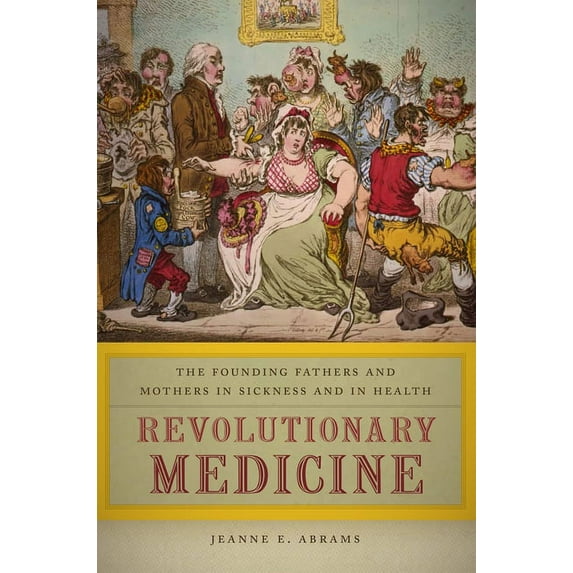
Hero image 0 of Revolutionary Medicine: The Founding Fathers and Mothers in Sickness and in Health, (Hardcover), 0 of 1
Revolutionary Medicine: The Founding Fathers and Mothers in Sickness and in Health, (Hardcover)
(No ratings yet)
Key item features
Publishers Weekly,We know their vaunted place in history: Presidents Washington, Adams, Jefferson, and Madison, and statesman, scientist, and pamphleteer Benjamin Franklin. But it's their work in public health-and their personal battles with illness-that makes this blend of political and medical history so engaging. Abrams (Jewish Women Pioneering the Frontier Trail) notes that there's nothing new about today's contentious debate over health care; the nation's founders were "acutely sensitive to health issues" affecting their families and community. Jefferson-who famously declared, "Science is my passion, politics my duty," and made no effort to mask his disdain for doctors-used his power to advocate for smallpox vaccinations, while Madison pushed the effort further with one of the earliest health bills, the Vaccine Act of 1813. Martha Washington poignantly noted, "Sickness is to be expected"; indeed, her husband suffered recurring malarial fevers, Franklin had episodes of gout, Jefferson was plagued with dysentery, and Madison had petit mal seizures. Abrams's meticulous medical portrait of colonial times-and its most powerful leaders-will be fascinating reading for students of both history and medicine. Illus. (Sept.) (c) Copyright PWxyz, LLC. All rights reserved.,Publishers Weekly,Publishers Weekly,We know their vaunted place in history: Presidents Washington, Adams, Jefferson, and Madison, and statesman, scientist, and pamphleteer Benjamin Franklin. But it's their work in public health-and their personal battles with illness-that makes this blend of political and medical history so engaging. Abrams (Jewish Women Pioneering the Frontier Trail) notes that there's nothing new about today's contentious debate over health care; the nation's founders were "acutely sensitive to health issues" affecting their families and community. Jefferson-who famously declared, "Science is my passion, politics my duty," and made no effort to mask his disdain for doctors-used his power to advocate for smallpox vaccinations, while Madison pushed the effort further with one of the earliest health bills, the Vaccine Act of 1813. Martha Washington poignantly noted, "Sickness is to be expected"; indeed, her husband suffered recurring malarial fevers, Franklin had episodes of gout, Jefferson was plagued with dysentery, and Madison had petit mal seizures. Abrams's meticulous medical portrait of colonial times-and its most powerful leaders-will be fascinating reading for students of both history and medicine. Illus. (Sept.) (c) Copyright PWxyz, LLC. All rights reserved.
Specs
- Book formatHardcover
- Fiction/nonfictionNon-Fiction
- GenreHistory
- Publication dateSeptember, 2013
- Pages314
- Reading levelGeneral (US: Trade)
Current price is USD$66.00
Price when purchased online
- Free shipping
 Free 90-day returns
How do you want your item?
Try 30 days of Free Shipping with Walmart+! Choose plan at checkout.
Ships to
Arrives by Tomorrow
.Order within 1 hr 7 min
Sold and shipped by Walmart.com

Free 90-day returns

This item is gift eligible
More seller options (4)
Starting from $97.09

Get free delivery, shipping and more*
*Restrictions apply Try Walmart+ now
About this item
Product details
An engaging history of the role that George Washington, Thomas Jefferson, and Benjamin Franklin played in the origins of public health in America
Before the advent of modern antibiotics, one's life could be abruptly shattered by contagion and death, and debility from infectious diseases and epidemics was commonplace for early Americans, regardless of social status. Concerns over health affected the founding fathers and their families as it did slaves, merchants, immigrants, and everyone else in North America. As both victims of illness and national leaders, the Founders occupied a unique position regarding the development of public health in America. Revolutionary Medicine refocuses the study of the lives of George and Martha Washington, Benjamin Franklin, Thomas Jefferson, John and Abigail Adams, and James and Dolley Madison away from the usual lens of politics to the unique perspective of sickness, health, and medicine in their era. For the founders, republican ideals fostered a reciprocal connection between individual health and the "health" of the nation. Studying the encounters of these American founders with illness and disease, as well as their viewpoints about good health, not only provides us with a richer and morenuanced insight into their lives, but also opens a window into the practice of medicine in the eighteenth century, which is at once intimate, personal, and first hand. Perhaps most importantly, today's American public health initiatives have their roots in the work of America's founders, for they recognized early on that government had compelling reasons to shoulder some new responsibilities with respect to ensuring the health and well-being of its citizenry. The state of medicine and public healthcare today is still a work in progress, but these founders played a significant role in beginning the conversation that shaped the contours of its development.
Publishers Weekly,We know their vaunted place in history: Presidents Washington, Adams, Jefferson, and Madison, and statesman, scientist, and pamphleteer Benjamin Franklin. But it's their work in public health-and their personal battles with illness-that makes this blend of political and medical history so engaging. Abrams (Jewish Women Pioneering the Frontier Trail) notes that there's nothing new about today's contentious debate over health care; the nation's founders were "acutely sensitive to health issues" affecting their families and community. Jefferson-who famously declared, "Science is my passion, politics my duty," and made no effort to mask his disdain for doctors-used his power to advocate for smallpox vaccinations, while Madison pushed the effort further with one of the earliest health bills, the Vaccine Act of 1813. Martha Washington poignantly noted, "Sickness is to be expected"; indeed, her husband suffered recurring malarial fevers, Franklin had episodes of gout, Jefferson was plagued with dysentery, and Madison had petit mal seizures. Abrams's meticulous medical portrait of colonial times-and its most powerful leaders-will be fascinating reading for students of both history and medicine. Illus. (Sept.) (c) Copyright PWxyz, LLC. All rights reserved.,Publishers Weekly,Publishers Weekly,We know their vaunted place in history: Presidents Washington, Adams, Jefferson, and Madison, and statesman, scientist, and pamphleteer Benjamin Franklin. But it's their work in public health-and their personal battles with illness-that makes this blend of political and medical history so engaging. Abrams (Jewish Women Pioneering the Frontier Trail) notes that there's nothing new about today's contentious debate over health care; the nation's founders were "acutely sensitive to health issues" affecting their families and community. Jefferson-who famously declared, "Science is my passion, politics my duty," and made no effort to mask his disdain for doctors-used his power to advocate for smallpox vaccinations, while Madison pushed the effort further with one of the earliest health bills, the Vaccine Act of 1813. Martha Washington poignantly noted, "Sickness is to be expected"; indeed, her husband suffered recurring malarial fevers, Franklin had episodes of gout, Jefferson was plagued with dysentery, and Madison had petit mal seizures. Abrams's meticulous medical portrait of colonial times-and its most powerful leaders-will be fascinating reading for students of both history and medicine. Illus. (Sept.) (c) Copyright PWxyz, LLC. All rights reserved.
info:
We aim to show you accurate product information. Manufacturers, suppliers and others provide what you see here, and we have not verified it.
Specifications
Book format
Hardcover
Fiction/nonfiction
Non-Fiction
Genre
History
Publication date
September, 2013
Warranty
Warranty information
Please be aware that the warranty terms on items offered for sale by third party Marketplace sellers may differ from those displayed in this section (if any). To confirm warranty terms on an item offered for sale by a third party Marketplace seller, please use the 'Contact seller' feature on the third party Marketplace seller's information page and request the item's warranty terms prior to purchase.
Similar items you might like
Based on what customers bought
Political Liberty: A History of the Conception in the Middle Ages and Modern Times, (Hardcover) $64.54
 $6454current price $64.54
Political Liberty: A History of the Conception in the Middle Ages and Modern Times, (Hardcover)
Our Cuba: Contextualizing a Vibrant History, (Hardcover) $67.99
 $6799current price $67.99
Our Cuba: Contextualizing a Vibrant History, (Hardcover)
Jewish Women Pioneering the Frontier Trail: A History in the American West, (Hardcover) $116.78
 $11678current price $116.78
Jewish Women Pioneering the Frontier Trail: A History in the American West, (Hardcover)
Phantom Plague: How Tuberculosis Shaped History, (Hardcover) $15.80
 $1580current price $15.80
Phantom Plague: How Tuberculosis Shaped History, (Hardcover)
The Retail Revolution in Health Care, (Hardcover) $71.44
 $7144current price $71.44
The Retail Revolution in Health Care, (Hardcover)
A View from Abroad: The Story of John and Abigail Adams in Europe, (Hardcover) $59.53
 $5953current price $59.53
A View from Abroad: The Story of John and Abigail Adams in Europe, (Hardcover)
Encyclopedia of Birth Control, (Hardcover) $68.74
 $6874current price $68.74
Encyclopedia of Birth Control, (Hardcover)
Elements in Bioethics and Neuroethics What Placebos Teach Us about Health and Care: A Philosopher Pops a Pill, (Hardcover) $64.74
 $6474current price $64.74
Elements in Bioethics and Neuroethics What Placebos Teach Us about Health and Care: A Philosopher Pops a Pill, (Hardcover)
Contributions in Medical Studies Hydropathic Highway to Health: Women and Water-Cure in Antebellum America, (Hardcover) $69.05
 $6905current price $69.05
Contributions in Medical Studies Hydropathic Highway to Health: Women and Water-Cure in Antebellum America, (Hardcover)
Hale's Medications & Mothers' Milk 2025-2026: A Manual of Lactational Pharmacology, (Paperback) $60.75
 $6075current price $60.75
Hale's Medications & Mothers' Milk 2025-2026: A Manual of Lactational Pharmacology, (Paperback)
American History: Thomas Jefferson and Maria Cosway: A Gordian Love Affair (Hardcover) $56.00
 $5600current price $56.00
American History: Thomas Jefferson and Maria Cosway: A Gordian Love Affair (Hardcover)
Chronicles of the Pilgrim Fathers of the Colony of Polymouth, from 1602 to 1625 (Hardcover) $44.32
 $4432current price $44.32
Chronicles of the Pilgrim Fathers of the Colony of Polymouth, from 1602 to 1625 (Hardcover)
Parents of Poor Children in England, 1580-1800, (Hardcover) $78.95
 $7895current price $78.95
Parents of Poor Children in England, 1580-1800, (Hardcover)
Lost Letters of the American Revolution: Uncovered, Unfiltered, Unforgettable, (Hardcover) $32.27
 $3227current price $32.27
Lost Letters of the American Revolution: Uncovered, Unfiltered, Unforgettable, (Hardcover)
Lineage Book (Hardcover) $39.95
 $3995current price $39.95
Lineage Book (Hardcover)
A Mother's Job, (Hardcover) $79.31
 $7931current price $79.31
A Mother's Job, (Hardcover)
Contributions in American History Bread and Roses Too: Studies of the Wobblies, Book 1, (Hardcover) $90.38
 $9038current price $90.38
Contributions in American History Bread and Roses Too: Studies of the Wobblies, Book 1, (Hardcover)
A History of Nursing Ideas: ., (Paperback) $124.68
 $12468current price $124.68
A History of Nursing Ideas: ., (Paperback)


Customer ratings & reviews
0 ratings|0 reviews
This item does not have any reviews yet
