

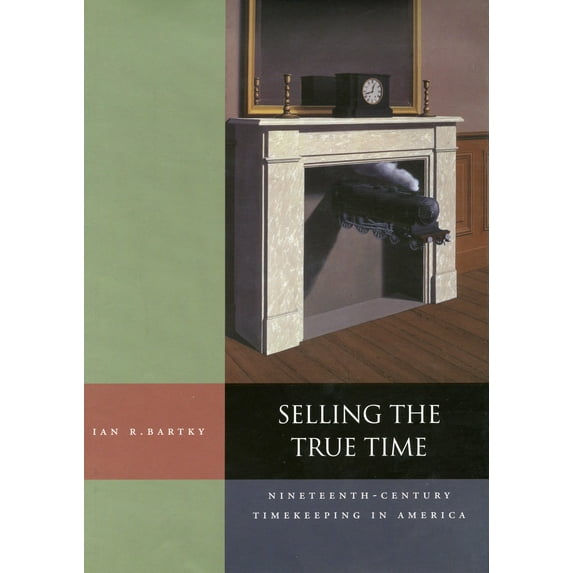
Hero image 0 of Selling the True Time : Nineteenth-Century Timekeeping in America (Hardcover), 0 of 1
Selling the True Time : Nineteenth-Century Timekeeping in America (Hardcover)
(No ratings yet)
Key item features
This book studies the transition from local to national timekeeping, a process that led to Standard Time—the world-wide system of timekeeping by which we all live. Prior to the railroads’ adoption of Standard Railway Time in 1883, timekeeping was entirely a local matter, and America lacked any uniform system to coordinate times and public activities. For example, in the middle of the nineteenth century, Boston had three authoritative times, which differed by seconds and minutes.
The story begins in the 1830s with the building of the first railroads. Since railway safety depended upon maintaining the temporal separation of trains through precise timing, railroads were the first to establish time standards to govern their operations. The railroads’ switch to five time standards indexed to the Greenwich meridian inaugurated the modern era of public timekeeping and led directly to cities adopting Greenwich-indexed civil time zones.
Central to the story are those college and university astronomers who, starting in the 1850s, sold time signals to nearby cities and railroads. From the start, they competed with other entrepreneurs trying to make money by selling time. Decades of negotiations, government lobbying, and battles over customers followed, all in the name of “public service.” Improvements by a host of clockmakers, civil and electrical engineers, telegraph and railway technicians, and instrument makers finally changed the market for accurate time. Public timekeeping became the realm of business investors.
Despite the efforts of astronomers and various of their Congressional supporters, who argued for the necessity of a national system of time authorized by the federal government, the railroads’ success with their own system blocked legislation for a national system of time until the First World War. By then, a single source for correct time dominated the public’s timekeeping: the U.S. Naval Observatory’s noon signal.
In this first comprehensive, scholarly history of timekeeping in America, the author has drawn upon a rich, untapped archival record, municipal and legislative documents, newspapers, and science and engineering journals to challenge several myths that have grown up around the subject.
The story begins in the 1830s with the building of the first railroads. Since railway safety depended upon maintaining the temporal separation of trains through precise timing, railroads were the first to establish time standards to govern their operations. The railroads’ switch to five time standards indexed to the Greenwich meridian inaugurated the modern era of public timekeeping and led directly to cities adopting Greenwich-indexed civil time zones.
Central to the story are those college and university astronomers who, starting in the 1850s, sold time signals to nearby cities and railroads. From the start, they competed with other entrepreneurs trying to make money by selling time. Decades of negotiations, government lobbying, and battles over customers followed, all in the name of “public service.” Improvements by a host of clockmakers, civil and electrical engineers, telegraph and railway technicians, and instrument makers finally changed the market for accurate time. Public timekeeping became the realm of business investors.
Despite the efforts of astronomers and various of their Congressional supporters, who argued for the necessity of a national system of time authorized by the federal government, the railroads’ success with their own system blocked legislation for a national system of time until the First World War. By then, a single source for correct time dominated the public’s timekeeping: the U.S. Naval Observatory’s noon signal.
In this first comprehensive, scholarly history of timekeeping in America, the author has drawn upon a rich, untapped archival record, municipal and legislative documents, newspapers, and science and engineering journals to challenge several myths that have grown up around the subject.
Specs
- Manual & guide typeInstruction Manual
- Book formatHardcover
- Edition1
- Pages328
- LanguageEnglish
- BrandIan R Bartky
Current price is USD$55.35
Price when purchased online
- Free shipping
 Free 30-day returns
How do you want your item?
Columbus, 43215
Arrives between May 9 - May 12
|
Sold and shipped by Endless Reads
4.760603882099209 stars out of 5, based on 1391 seller reviews(4.8)1391 seller reviews

Free 30-day returns - in store or online
More seller options (5)
Starting from $57.56
About this item
Product details
This first comprehensive, scholarly history of timekeeping in America studies the transition from local to national timekeeping, a process that led to Standard Time—the worldwide system of timekeeping by which we all live. The book describes the contributions of the railroad industry, university astronomers, clockmakers, and civil and electrical engineers.
This book studies the transition from local to national timekeeping, a process that led to Standard Time—the world-wide system of timekeeping by which we all live. Prior to the railroads’ adoption of Standard Railway Time in 1883, timekeeping was entirely a local matter, and America lacked any uniform system to coordinate times and public activities. For example, in the middle of the nineteenth century, Boston had three authoritative times, which differed by seconds and minutes.
The story begins in the 1830s with the building of the first railroads. Since railway safety depended upon maintaining the temporal separation of trains through precise timing, railroads were the first to establish time standards to govern their operations. The railroads’ switch to five time standards indexed to the Greenwich meridian inaugurated the modern era of public timekeeping and led directly to cities adopting Greenwich-indexed civil time zones.
Central to the story are those college and university astronomers who, starting in the 1850s, sold time signals to nearby cities and railroads. From the start, they competed with other entrepreneurs trying to make money by selling time. Decades of negotiations, government lobbying, and battles over customers followed, all in the name of “public service.” Improvements by a host of clockmakers, civil and electrical engineers, telegraph and railway technicians, and instrument makers finally changed the market for accurate time. Public timekeeping became the realm of business investors.
Despite the efforts of astronomers and various of their Congressional supporters, who argued for the necessity of a national system of time authorized by the federal government, the railroads’ success with their own system blocked legislation for a national system of time until the First World War. By then, a single source for correct time dominated the public’s timekeeping: the U.S. Naval Observatory’s noon signal.
In this first comprehensive, scholarly history of timekeeping in America, the author has drawn upon a rich, untapped archival record, municipal and legislative documents, newspapers, and science and engineering journals to challenge several myths that have grown up around the subject.
The story begins in the 1830s with the building of the first railroads. Since railway safety depended upon maintaining the temporal separation of trains through precise timing, railroads were the first to establish time standards to govern their operations. The railroads’ switch to five time standards indexed to the Greenwich meridian inaugurated the modern era of public timekeeping and led directly to cities adopting Greenwich-indexed civil time zones.
Central to the story are those college and university astronomers who, starting in the 1850s, sold time signals to nearby cities and railroads. From the start, they competed with other entrepreneurs trying to make money by selling time. Decades of negotiations, government lobbying, and battles over customers followed, all in the name of “public service.” Improvements by a host of clockmakers, civil and electrical engineers, telegraph and railway technicians, and instrument makers finally changed the market for accurate time. Public timekeeping became the realm of business investors.
Despite the efforts of astronomers and various of their Congressional supporters, who argued for the necessity of a national system of time authorized by the federal government, the railroads’ success with their own system blocked legislation for a national system of time until the First World War. By then, a single source for correct time dominated the public’s timekeeping: the U.S. Naval Observatory’s noon signal.
In this first comprehensive, scholarly history of timekeeping in America, the author has drawn upon a rich, untapped archival record, municipal and legislative documents, newspapers, and science and engineering journals to challenge several myths that have grown up around the subject.
info:
We aim to show you accurate product information. Manufacturers, suppliers and others provide what you see here, and we have not verified it.
Specifications
Manual & guide type
Instruction Manual
Book format
Hardcover
Edition
1
Pages
328
Warranty
Warranty information
Please be aware that the warranty terms on items offered for sale by third party Marketplace sellers may differ from those displayed in this section (if any). To confirm warranty terms on an item offered for sale by a third party Marketplace seller, please use the 'Contact seller' feature on the third party Marketplace seller's information page and request the item's warranty terms prior to purchase.
Similar items you might like
Based on what customers bought
Class and Contemporary British Culture, (Hardcover) $56.14
 $5614current price $56.14
Class and Contemporary British Culture, (Hardcover)
Pre-Owned A Taste of the Country (Hardcover) 0898211808 9780898211801 $8.74
 $874current price $8.74
Pre-Owned A Taste of the Country (Hardcover) 0898211808 9780898211801
Stripers on the Fly, (Hardcover) $27.09
 $2709current price $27.09
Stripers on the Fly, (Hardcover)
The Objects of Credence, (Hardcover) $84.06
 $8406current price $84.06
The Objects of Credence, (Hardcover)
Pre-Owned The Encyclopedia of Creative Cooking (Hardcover) 0517309726 9780517309728 $4.22
 3 optionsAvailable in additional 3 options$422current price $4.22
Pre-Owned The Encyclopedia of Creative Cooking (Hardcover) 0517309726 9780517309728
Pre-Owned Signing: Signed English: A Basic Guide (Paperback) 0517561328 9780517561324 $3.99
 $399current price $3.99
Pre-Owned Signing: Signed English: A Basic Guide (Paperback) 0517561328 9780517561324
What to Do When the Lights Go Out: Be Prepared When the Modern World Goes Wrong, (Paperback) $19.99
 $1999current price $19.99
What to Do When the Lights Go Out: Be Prepared When the Modern World Goes Wrong, (Paperback)
Pre-Owned The Bluejackets' Manual (Paperback) 0870211110 9780870211119 $8.09 Was $9.24
 $809current price $8.09, Was $9.24$9.24
Pre-Owned The Bluejackets' Manual (Paperback) 0870211110 9780870211119
Twentieth Century Home Cook Book (Hardcover) $39.95
 $3995current price $39.95
Twentieth Century Home Cook Book (Hardcover)
Pre-Owned Stuff Every Gardener Should Know (Hardcover) 1594749566 9781594749568 $4.03
 3 optionsAvailable in additional 3 options$403current price $4.03
Pre-Owned Stuff Every Gardener Should Know (Hardcover) 1594749566 9781594749568
A Manual of Anatomy (Hardcover) $44.99
 $4499current price $44.99
A Manual of Anatomy (Hardcover)
The Meaning of Everyday Occupation (Edition 3) (Hardcover) $77.18
 $7718current price $77.18
The Meaning of Everyday Occupation (Edition 3) (Hardcover)
The Cycle of Growth, (Hardcover) $57.32
 $5732current price $57.32
The Cycle of Growth, (Hardcover)
The Owner's Manual for Thriving Relationships, (Hardcover) $54.24
 $5424current price $54.24
The Owner's Manual for Thriving Relationships, (Hardcover)
Real Life Construction Management Guide From A - Z: New Version, (Hardcover) $52.99
 $5299current price $52.99
Real Life Construction Management Guide From A - Z: New Version, (Hardcover)
Applied Linear Models with SAS, (Hardcover) $87.52
 $8752current price $87.52
Applied Linear Models with SAS, (Hardcover)
Transformission, (Hardcover) $24.97
 $2497current price $24.97
Transformission, (Hardcover)
Traveling East and Beyond: Vol II (Hardcover) $36.50
 $3650current price $36.50
Traveling East and Beyond: Vol II (Hardcover)
American Beginnings, 1500-1900: The Making of Tocqueville's America : Law and Association in the Early United States (Hardcover) $47.88
 $4788current price $47.88
American Beginnings, 1500-1900: The Making of Tocqueville's America : Law and Association in the Early United States (Hardcover)

Customer ratings & reviews
0 ratings|0 reviews
This item does not have any reviews yet
