

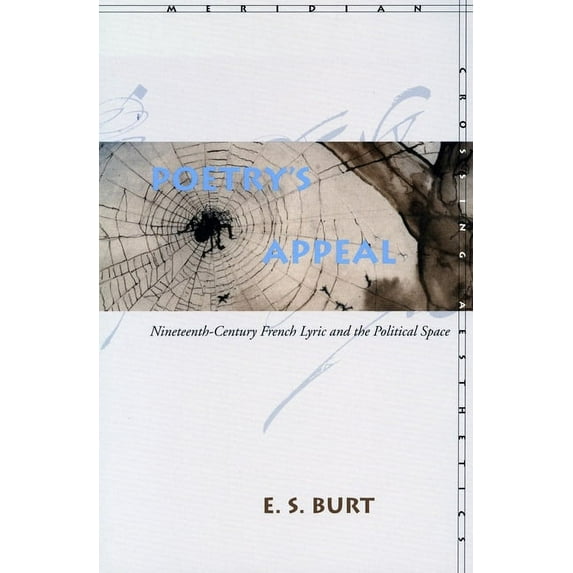
Hero image 0 of Meridian: Crossing Aesthetics: Poetry’s Appeal : Nineteenth-Century French Lyric and the Political Space (Hardcover), 0 of 1
Meridian: Crossing Aesthetics: Poetry’s Appeal : Nineteenth-Century French Lyric and the Political Space (Hardcover)
(No ratings yet)
Key item features
Socrates banished poetry from the ideal republic, adopting the philosophical position that poetic language operates outside the conventions of public discourse and is private in expression. But what does the banished language of poetry say about its relation to public space? Is it possible to draw a line severing the language of beauty from the language of truth? Derrida asks whether the line ought rather to pass between Western metaphysics, with its logic of polar opposites, and another way that does not organize everything in oppositional terms. The verbal economy organized around the poem as inscription, for instance, fits awkwardly with a division between a public discourse under the aegis of truth and a private one regulated by aesthetic pleasure.
Poetry's Appeal takes the reemergence of a viable poetry in the politicized culture of revolutionary and post-revolutionary France as a signal that poetry's sentence of exile from the public arena is unresolved. It finds that poetry addresses history and the political through a disjunction between its illusory status as a song of private, lyrical intent and its actual state as a material inscription, inevitably public in character.
The book confronts several issues raised by the gap between poetry's aesthetic status and its material state. It shows that this gap allows poetry to make a strong critique of symbols as weapons for waging ideological warfare. As lyric, a poem naturalizes linguistic structures whose artificiality, as inscription, it makes manifest. Inscription thus enables the poem to act subversively against the ideology it supposedly supports. Furthermore, the chances and economies of the letter, the mark, and the page can have productive, positing power in poetry. The author argues that the zones and pockets that emerge thanks to nonsignifying elements of language have analogies for reading the city space.
In chapters on Chénier, Hugo, Baudelaire, Mallarmé, and Valéry, the book details some of the struggles between the ideological and material sides of poetry with the nineteenth-century remappings of political space: memory and the archive, the censorship of material history, the propping of founding performatives, the legibility of founding texts, the need to redefine action where technique is productive, and the recognition and assimilation of zones owed to technique.
Poetry's Appeal takes the reemergence of a viable poetry in the politicized culture of revolutionary and post-revolutionary France as a signal that poetry's sentence of exile from the public arena is unresolved. It finds that poetry addresses history and the political through a disjunction between its illusory status as a song of private, lyrical intent and its actual state as a material inscription, inevitably public in character.
The book confronts several issues raised by the gap between poetry's aesthetic status and its material state. It shows that this gap allows poetry to make a strong critique of symbols as weapons for waging ideological warfare. As lyric, a poem naturalizes linguistic structures whose artificiality, as inscription, it makes manifest. Inscription thus enables the poem to act subversively against the ideology it supposedly supports. Furthermore, the chances and economies of the letter, the mark, and the page can have productive, positing power in poetry. The author argues that the zones and pockets that emerge thanks to nonsignifying elements of language have analogies for reading the city space.
In chapters on Chénier, Hugo, Baudelaire, Mallarmé, and Valéry, the book details some of the struggles between the ideological and material sides of poetry with the nineteenth-century remappings of political space: memory and the archive, the censorship of material history, the propping of founding performatives, the legibility of founding texts, the need to redefine action where technique is productive, and the recognition and assimilation of zones owed to technique.
Specs
- Book formatHardcover
- Fiction/nonfictionNon-Fiction
- GenreLiterature & Fiction
- Publication dateApril, 2000
- Pages312
- Edition1st Edition
Current price is USD$129.51
Price when purchased online
- Free shipping
 Free 90-day returns
How do you want your item?
Try 30 days for just $1! Choose a plan at checkout.
Ships to
Arrives by Tue, May 12
.Order within 12 hr 49 min
Sold and shipped by Walmart.com

Free 90-day returns

This item is gift eligible
More seller options (3)
Starting from $146.42

Try 30 days of Walmart+ for just $1!
T&C apply. Claim offer now
About this item
Product details
Poetry's Appeal studies the reemergence of a viable poetry in the politicized culture of revolutionary and post-revolutionary France. It finds that poetry addresses history and the political through a disjunction between its illusory status as a song of private, lyrical intent and its actual state as a material inscription, inevitably public in character.
Socrates banished poetry from the ideal republic, adopting the philosophical position that poetic language operates outside the conventions of public discourse and is private in expression. But what does the banished language of poetry say about its relation to public space? Is it possible to draw a line severing the language of beauty from the language of truth? Derrida asks whether the line ought rather to pass between Western metaphysics, with its logic of polar opposites, and another way that does not organize everything in oppositional terms. The verbal economy organized around the poem as inscription, for instance, fits awkwardly with a division between a public discourse under the aegis of truth and a private one regulated by aesthetic pleasure.
Poetry's Appeal takes the reemergence of a viable poetry in the politicized culture of revolutionary and post-revolutionary France as a signal that poetry's sentence of exile from the public arena is unresolved. It finds that poetry addresses history and the political through a disjunction between its illusory status as a song of private, lyrical intent and its actual state as a material inscription, inevitably public in character.
The book confronts several issues raised by the gap between poetry's aesthetic status and its material state. It shows that this gap allows poetry to make a strong critique of symbols as weapons for waging ideological warfare. As lyric, a poem naturalizes linguistic structures whose artificiality, as inscription, it makes manifest. Inscription thus enables the poem to act subversively against the ideology it supposedly supports. Furthermore, the chances and economies of the letter, the mark, and the page can have productive, positing power in poetry. The author argues that the zones and pockets that emerge thanks to nonsignifying elements of language have analogies for reading the city space.
In chapters on Chénier, Hugo, Baudelaire, Mallarmé, and Valéry, the book details some of the struggles between the ideological and material sides of poetry with the nineteenth-century remappings of political space: memory and the archive, the censorship of material history, the propping of founding performatives, the legibility of founding texts, the need to redefine action where technique is productive, and the recognition and assimilation of zones owed to technique.
Poetry's Appeal takes the reemergence of a viable poetry in the politicized culture of revolutionary and post-revolutionary France as a signal that poetry's sentence of exile from the public arena is unresolved. It finds that poetry addresses history and the political through a disjunction between its illusory status as a song of private, lyrical intent and its actual state as a material inscription, inevitably public in character.
The book confronts several issues raised by the gap between poetry's aesthetic status and its material state. It shows that this gap allows poetry to make a strong critique of symbols as weapons for waging ideological warfare. As lyric, a poem naturalizes linguistic structures whose artificiality, as inscription, it makes manifest. Inscription thus enables the poem to act subversively against the ideology it supposedly supports. Furthermore, the chances and economies of the letter, the mark, and the page can have productive, positing power in poetry. The author argues that the zones and pockets that emerge thanks to nonsignifying elements of language have analogies for reading the city space.
In chapters on Chénier, Hugo, Baudelaire, Mallarmé, and Valéry, the book details some of the struggles between the ideological and material sides of poetry with the nineteenth-century remappings of political space: memory and the archive, the censorship of material history, the propping of founding performatives, the legibility of founding texts, the need to redefine action where technique is productive, and the recognition and assimilation of zones owed to technique.
info:
We aim to show you accurate product information. Manufacturers, suppliers and others provide what you see here, and we have not verified it.
Specifications
Book format
Hardcover
Fiction/nonfiction
Non-Fiction
Genre
Literature & Fiction
Publication date
April, 2000
Warranty
Warranty information
Please be aware that the warranty terms on items offered for sale by third party Marketplace sellers may differ from those displayed in this section (if any). To confirm warranty terms on an item offered for sale by a third party Marketplace seller, please use the 'Contact seller' feature on the third party Marketplace seller's information page and request the item's warranty terms prior to purchase.
Similar items you might like
Based on what customers bought
Modernist Latitudes Modernism and the Middle Passage, (Hardcover) $112.60
 $11260current price $112.60
Modernist Latitudes Modernism and the Middle Passage, (Hardcover)
People for Our Time Political Thinkers for Our Time, (Hardcover) $98.62 Was $130.00
 $9862current price $98.62, Was $130.00$130.00
People for Our Time Political Thinkers for Our Time, (Hardcover)
Meridian: Crossing Aesthetics Matchbook: Essays in Deconstruction, (Hardcover) $129.11
 $12911current price $129.11
Meridian: Crossing Aesthetics Matchbook: Essays in Deconstruction, (Hardcover)
Building in Hot and Humid Regions: Historical Perspective and Technological Advances, (Hardcover) $126.91
 $12691current price $126.91
Building in Hot and Humid Regions: Historical Perspective and Technological Advances, (Hardcover)
Anthem Nineteenth-Century Darwin, Tennyson and Their Readers: Explorations in Victorian Literature and Science, (Hardcover) $120.24
 $12024current price $120.24
Anthem Nineteenth-Century Darwin, Tennyson and Their Readers: Explorations in Victorian Literature and Science, (Hardcover)
Modernist Latitudes Reorientalism: From Avant-Garde to Soviet National Form, (Hardcover) $111.73
 $11173current price $111.73
Modernist Latitudes Reorientalism: From Avant-Garde to Soviet National Form, (Hardcover)
Meridian: Crossing Aesthetics: Faux Pas (Hardcover) $130.00
 $13000current price $130.00
Meridian: Crossing Aesthetics: Faux Pas (Hardcover)
Transcultural Aesthetics Art, Philosophy, and Ideology: Writings on Aesthetics and Visual Culture from the Avantgarde to Postsocialism, Book 4, (Hardcover) $140.61
 $14061current price $140.61
Transcultural Aesthetics Art, Philosophy, and Ideology: Writings on Aesthetics and Visual Culture from the Avantgarde to Postsocialism, Book 4, (Hardcover)
Modernist Latitudes Modernism at the Beach: Queer Ecologies and the Coastal Commons, (Hardcover) $111.73
 $11173current price $111.73
Modernist Latitudes Modernism at the Beach: Queer Ecologies and the Coastal Commons, (Hardcover)
Transits: Literature, Thought & Culture, Poetic Sisters: Early Eighteenth-Century Women Poets, (Hardcover) $135.00
 $13500current price $135.00
Transits: Literature, Thought & Culture, Poetic Sisters: Early Eighteenth-Century Women Poets, (Hardcover)
Protest, Culture & Society Political Graffiti in Critical Times: The Aesthetics of Street Politics, Book 28, (Hardcover) $156.65
 $15665current price $156.65
Protest, Culture & Society Political Graffiti in Critical Times: The Aesthetics of Street Politics, Book 28, (Hardcover)
Global Aesthetic Research Foucault on the Arts and Letters: Perspectives for the 21st Century, (Hardcover) $120.62
 $12062current price $120.62
Global Aesthetic Research Foucault on the Arts and Letters: Perspectives for the 21st Century, (Hardcover)
Oxford Studies in Medieval Literature an Arts of Disruption: Allegory and Piers Plowman, (Hardcover) $133.97
 $13397current price $133.97
Oxford Studies in Medieval Literature an Arts of Disruption: Allegory and Piers Plowman, (Hardcover)
Aesthetic Revolutions and Twentieth-Century Avant-Garde Movements, (Hardcover) $135.96
 $13596current price $135.96
Aesthetic Revolutions and Twentieth-Century Avant-Garde Movements, (Hardcover)
Meridian: Crossing Aesthetics Posthumous People: Vienna at the Turning Point, (Hardcover) $110.28
 $11028current price $110.28
Meridian: Crossing Aesthetics Posthumous People: Vienna at the Turning Point, (Hardcover)
Cambridge Studies in Nineteenth-Century Idleness and Aesthetic Consciousness, 1815-1900, Book 112, (Hardcover) $124.93
 $12493current price $124.93
Cambridge Studies in Nineteenth-Century Idleness and Aesthetic Consciousness, 1815-1900, Book 112, (Hardcover)
Modernism, Mass Culture, and the Aesthetics of Obscenity, (Hardcover) $114.00
 $11400current price $114.00
Modernism, Mass Culture, and the Aesthetics of Obscenity, (Hardcover)
Print and the Novel in 19th Century Kerala: Reconsidering Colonial Modernity, (Hardcover) $117.77
 $11777current price $117.77
Print and the Novel in 19th Century Kerala: Reconsidering Colonial Modernity, (Hardcover)
Curiosity and the Aesthetics of Travel-Writing, 1770-1840: From an Antique Land', (Hardcover) $105.00
 $10500current price $105.00
Curiosity and the Aesthetics of Travel-Writing, 1770-1840: From an Antique Land', (Hardcover)
Oxford Modern Languages & Literature Mon Fin de Millénaire French Fiction: The Aesthetics of Crisis, (Hardcover) $127.26
 $12726current price $127.26
Oxford Modern Languages & Literature Mon Fin de Millénaire French Fiction: The Aesthetics of Crisis, (Hardcover)
Customer ratings & reviews
0 ratings|0 reviews
This item does not have any reviews yet

Related pages
- Lights Siberia
- Milton Broughton
- London Fire 1666
- Roman Villa
- United Lubbock
- Europa Life
- Australian & Oceanian Poetry Books
- Middle East Historical Teen & Young Adult Books
- General European Poetry Books
- Russian & Former Soviet Union Art Books
- Tudor & Elizabethan Era Great Britain History Books
- Victorian Era Great Britain History Books