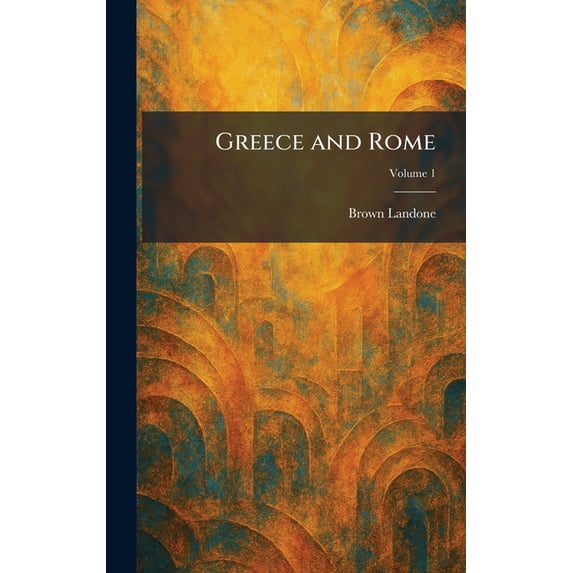
"Greece and Rome" offers a comprehensive exploration into the foundations of Western civilization, examining the rise, cultural achievements, and political evolution of the two most influential powers of antiquity. Edited by Brown Landone, this volume provides a detailed survey of the Hellenic world and the Roman Empire, tracing their development from early tribal origins to the heights of imperial dominance.
The work delves into the philosophical, artistic, and legal contributions that continue to shape modern society. Readers will find accounts of the democratic ideals born in Athens, the martial prowess of Sparta, and the administrative brilliance that allowed Rome to unify the Mediterranean world. Through a blend of historical narrative and cultural analysis, the book illuminates the everyday lives of citizens, the strategies of great leaders, and the religious practices that defined these eras.
As a significant historical overview, "Greece and Rome" serves as an essential resource for students of classical studies and those interested in the enduring legacy of the ancient world. It captures the spirit of an era defined by intellectual curiosity and monumental ambition, presenting the story of Greece and Rome as a singular, interconnected saga of human progress.
This work has been selected by scholars as being culturally important, and is part of the knowledge base of civilization as we know it. This work was reproduced from the original artifact, and remains as true to the original work as possible. Therefore, you may see the original copyright references, library stamps (as most of these works have been housed in our most important libraries around the world), and other notations in the work.
This work is in the public domain in the United States of America, and possibly other nations. Within the United States, you may freely copy and distribute this work, as no entity (individual or corporate) has a copyright on the body of the work.
As a reproduction of a historical artifact, this work may contain missing or blurred pages, poor pictures, errant marks, etc. Scholars believe, and we concur, that this work is important enough to be preserved, reproduced, and made generally available to the public. We appreciate your support of the preservation process, and thank you for being an important part of keeping this knowledge alive and relevant.