BOOK DESCRIPTION
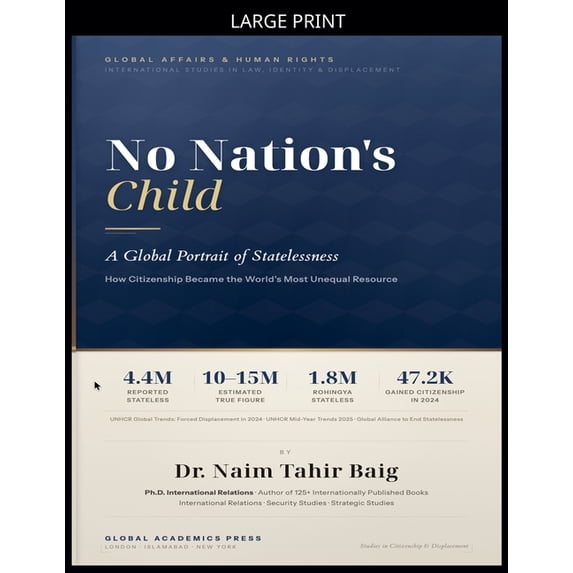
No Nation's Child: A Global Portrait of Statelessness
How Citizenship Became the World's Most Unequal Resource
By Dr. Naim Tahir Baig
Every night, children are born into a legal condition that most of the world has never heard of: statelessness. They enter a world that requires a nationality to access education, healthcare, property, marriage, justice, and the most basic protections of the law - and they possess none. UNHCR's most recent data records 4.4 million stateless people across 101 countries - a figure that its own Global Trends report explicitly acknowledges to be a severe undercount, with approximately half of all countries reporting no statelessness data at all, and the true global total considered considerably larger. These are the people this book is about.
No Nation's Child: A Global Portrait of Statelessness is a work of narrative scholarship that traces the origins, geography, and moral architecture of one of the most consequential and least examined injustices of the modern world. Drawing on research in international law, political philosophy, and regional case studies, Dr. Naim Tahir Baig presents a comprehensive, accessible account of statelessness as a global phenomenon - not merely a series of isolated humanitarian emergencies, but a structural feature of the nation-state system itself.
The book advances three interlocking arguments. First, statelessness is not an accident of history; it is a predictable output of a system built on mutually exclusive national identities applied across populations that were never neatly divisible by ethnicity, religion, or geography. From the Nansen passport issued to Russian émigrés from 1922, to the decolonisation borders of the mid-twentieth century, to the Dominican Republic's Constitutional Tribunal ruling of 2013 that retroactively stripped citizenship from approximately 200,000 Dominican-born people of Haitian descent, the modern state has repeatedly chosen sovereignty over the human beings sovereignty was supposed to serve. Second, birthright citizenship - whether by territory (jus soli) or by descent (jus sanguinis) - functions, as political philosopher Ayelet Shachar argues in The Birthright Lottery (Harvard University Press, 2009), as a form of inherited property: a valuable entitlement transmitted by law to a restricted group of recipients under conditions that perpetuate the transfer of this prerogative to their heirs. The consequences are measurable. According to the 2025 Henley Passport Index, a German passport grants its holder visa-free or visa-on-arrival access to 189 countries. An Afghan passport - ranked last in the same index - grants access to approximately 25 to 26 countries. This disparity, built entirely on the accident of birth, represents a form of structural global inequality more consequential than most economic measures. Third, the international legal frameworks designed to protect stateless people - the 1954 Convention Relating to the Status of Stateless Persons, the 1961 Convention on the Reduction of Statelessness, and UNHCR's formal mandate on statelessness (established by UN General Assembly Resolution 50/152 in 1995) - share a fatal structural flaw: they require states to act but provide no mechanism to compel them to do so.
No Nation's Child is essential reading for scholars of international law, political philosophy, human rights, and