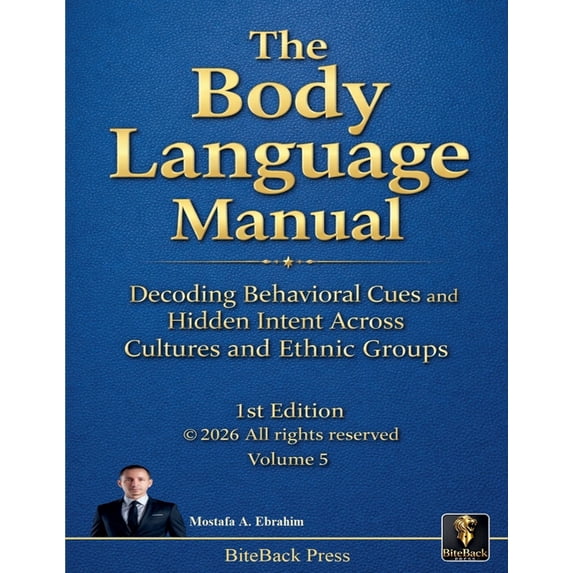
"The Body Language Manual: Decoding Behavioral Cues and Hidden Intent Across Cultures and Ethnic Groups" addresses the most persistent challenge in nonverbal analysis: accurate interpretation across cultural, contextual, and individual differences. Moving decisively beyond universalist myths and pop-psychology shortcuts, this volume establishes a neurobiologically grounded framework for distinguishing meaningful behavioral deviations from culturally normative expression.
Volume 5 introduces the dual-baseline methodology, calibrating both individual habitual patterns and culturally specific display rules before drawing inferences. Through meticulously researched comparative tables, practitioners learn to differentiate Southeast Asian restraint (reflecting hierarchy sensitivity) from deception, Latin American vocal animation (signaling relational engagement) from instability, and Indigenous minimal expressivity (encoding respect) from disengagement. Each chapter systematically deconstructs high-risk misinterpretations while providing actionable analytical guidance for diplomats, negotiators, clinicians, intelligence professionals, and organizational leaders operating in multicultural environments.
The manual maintains rigorous ethical boundaries throughout, emphasizing that body language reveals shifts in internal state, not intent, truth status, or moral character. Dedicated sections address power asymmetry in behavioral assessment, neurodiversity considerations, informed consent requirements, and the critical distinction between cognitive load and emotional arousal. Rather than promising infallible "lie detection," this volume equips readers with probabilistic reasoning tools that acknowledge uncertainty while enhancing situational awareness.
Featuring over 40 culture-specific reference tables covering facial expressions, paralanguage (pitch, volume, resonance, inflection), gestures, proxemics, and autonomic signals, Volume 5 transforms body language analysis from a speculative art into a disciplined practice of contextual pattern recognition. When integrated with the foundational principles established in preceding volumes, this manual enables professionals to navigate high-stakes human interactions with greater precision, cultural humility, and ethical responsibility, recognizing that the most sophisticated reading of others begins with awareness of one's own interpretive biases.
As part of the "Political Reviews" series, this volume situates nonverbal behavior within the analysis of power, legitimacy, negotiation dynamics, and elite decision-making across political and institutional settings.
It extends the series' commitment to evidence-based political analysis by treating human signaling as a strategic variable in diplomacy, governance, and international affairs.
BiteBack Press