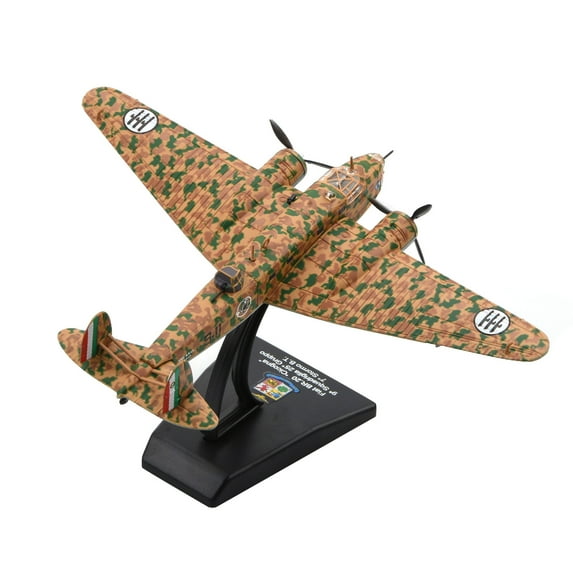
Features:
1. Model Plane: WWII Italian Air Force For Fiat BR.20 Cicogna Stork Bomber
2. Collection Plane: WWII Italian Air Force For Fiat BR.20 Cicogna Stork Bomber Model 1:144 Scale Model Length Is 4.7in
3. Prototype Airplanes: The Model Airplane Is Strictly Restored According To The Original Aircraft Proportions And Details. High Quality Die Cast Alloy Model.
4. Decor Model: Model Plane Is Very Suitable To Decorate Your Desk, Showcase And Shelf.
5. Perfect Gifts: The Great Gift Choice For Birthday, Christmas, New Year To Your Lover, Family And Friends, Also Suitable For Plane Collection Enthusiast.
Specifications:
Product Model: WWII Italian Air Force For Fiat BR.20 Cicogna Stork Bomber
Product Scale: 1:144
Product Material: Alloy+Plastic
Product Size: 12cm X 15cm
Playability: Bomber Propeller Can Rotate, The Base Is Detachable
Plane Prototype History:
The For Fiat BR.20 Cicogna Was A Twin Engine Medium Bomber Used By Italy During World War II, Developed By Fiat. It Was Not Only An Important Bomber Of The Italian Air Force During World War II, But Also Had A Unique International Service Experience, Especially In Connection With The Far East Theater. The Development Of The For Fiat BR.20 Began In 1934 With The Aim Of Meeting The Italian Air Force' S Demand For Modern Medium Bombers. Its Design Adopted Advanced Stress Skin Technology And All Metal Structure At That Time (The Front Half Of The Fuselage Is Made Of Hard Aluminum Skin, And The Back Half Is Made Of Canvas Skin), Making The Fuselage Sturdy. Its Dual Vertical Tail Design Provides A Good Backward View For The Gunner On The Back Of The Aircraft. However, The BR.20 Also Has Some Shortcomings: Its For Fiat A.80 Rc.41 Engine Has Poor Reliability And Is Difficult To Maintain; The Defensive Firepower Is Relatively Weak. Although Equipped With Three Machine Guns (One Spherical Machine Gun Mount At The Nose, One Retractable Machine Gun Mount At The Back, And One Retractable Machine Gun Mount At The Abdomen), They Are All 7.7mm Caliber (Later Upgraded From Br.20m To 12.7mm), And There Are Blind Spots In The Firing Range; Its Fuel Tank Lacks Protection And Is Prone To Being Hit And Catching Fire. The Battlefield Footprint Of BR.20 Covers Europe And Asia, Including The Spanish Civil War (1937-1939), The Chinese Battlefield (1938-1939), And The European And North African Battlefield (1940-1943). In Addition To Italy And Japan, The BR.20 Was Also Exported To Spain (Franco Air Force Purchased 25 Aircraft) And Venezuela (In Small Quantities). Its Total Production Is Approximately 530 To 600 Aircraft, Including The Basic Model BR.20, The Improved Br.20M (With A Production Of 264 Aircraft), And The Final Model Br.20bis (With 15 Aircraft Produced). The For Fiat BR.20 Stork Bomber Was One Of The Representative Works Of The Italian Aviation Industry In The Early Stages Of World War II. It Was Designed To Be Sturdy, Had Good Range And Payload Capacity, And Was A Relatively Modern Aircraft In The Mid-1930s. However, With The Development Of The War, Its Engine Reliability Issues, Insufficient Defensive Firepower, And Gradually Outdated Performance Became Increasingly Prominent, And It Suffered Significant Losses On Various Battlefields. It Witnessed The History Of The Italian Air Force In World War Ii And Also Reflected From A Small Perspective The International Military Cooperation And The Diffusion Of War Technology.
Packaging Includes:
1* WWII Italian Air Force For Fiat BR.20 Cicogna Stork Bomber Model
1* Display Stand