

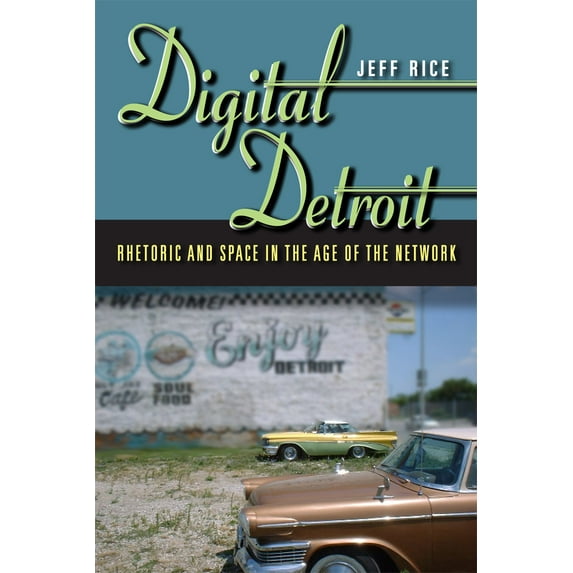
Digital Detroit : Rhetoric and Space in the Age of the Network (Paperback)
Key item features
Since the 1967 riots that ripped apart the city, Detroit has traditionally been viewed either as a place in ruins or a metropolis on the verge of rejuvenation. In Digital Detroit: Rhetoric and Space in the Age of the Network, author Jeff Rice goes beyond the notion of Detroit as simply a city of two ideas. Instead he explores the city as a web of multiple meanings which, in the digital age, come together in the city’s spaces to form a network that shapes the writing, the activity, and the very thinking of those around it.
Rice focuses his study on four of Detroit’s most iconic places—Woodward Avenue, the Maccabees Building, Michigan Central Station, and 8 Mile—covering each in a separate chapter. Each of these chapters explains one of the four features of network rhetoric: folksono(me), the affective interface, response, and decision making. As these rhetorical features connect, they form the overall network called Digital Detroit. Rice demonstrates how new media, such as podcasts, wikis, blogs, interactive maps, and the Internet in general, knit together Detroit into a digital network whose identity is fluid and ever-changing. In telling Detroit’s spatial story, Rice deftly illustrates how this new media, as a rhetorical practice, ultimately shapes understandings of space in ways that computer applications and city planning often cannot. The result is a model for a new way of thinking and interacting with space and the imagination, and for a better understanding of the challenges network rhetorics pose for writing.
Specs
- Manual & guide typeInstruction Manual
- Book formatPaperback
- Pages264
- LanguageEnglish
- BrandJeff Rice
- Pub date2012-02-21
- Free shipping
 Free 30-day returns
How do you want your item?


About this item
Product details
Since the 1967 riots that ripped apart the city, Detroit has traditionally been viewed either as a place in ruins or a metropolis on the verge of rejuvenation. In Digital Detroit: Rhetoric and Space in the Age of the Network, author Jeff Rice goes beyond the notion of Detroit as simply a city of two ideas. Instead he explores the city as a web of multiple meanings which, in the digital age, come together in the city's spaces to form a network that shapes the writing, the activity, and the very thinking of those around it.
Rice focuses his study on four of Detroit's most iconic places--Woodward Avenue, the Maccabees Building, Michigan Central Station, and 8 Mile--covering each in a separate chapter. Each of these chapters explains one of the four features of network rhetoric: folksono(me), the affective interface, response, and decision making. As these rhetorical features connect, they form the overall network called Digital Detroit. Rice demonstrates how new media, such as podcasts, wikis, blogs, interactive maps, and the Internet in general, knit together Detroit into a digital network whose identity is fluid and ever-changing. In telling Detroit's spatial story, Rice deftly illustrates how this new media, as a rhetorical practice, ultimately shapes understandings of space in ways that computer applications and city planning often cannot. The result is a model for a new way of thinking and interacting with space and the imagination, and for a better understanding of the challenges network rhetorics pose for writing.
Since the 1967 riots that ripped apart the city, Detroit has traditionally been viewed either as a place in ruins or a metropolis on the verge of rejuvenation. In Digital Detroit: Rhetoric and Space in the Age of the Network, author Jeff Rice goes beyond the notion of Detroit as simply a city of two ideas. Instead he explores the city as a web of multiple meanings which, in the digital age, come together in the city’s spaces to form a network that shapes the writing, the activity, and the very thinking of those around it.
Rice focuses his study on four of Detroit’s most iconic places—Woodward Avenue, the Maccabees Building, Michigan Central Station, and 8 Mile—covering each in a separate chapter. Each of these chapters explains one of the four features of network rhetoric: folksono(me), the affective interface, response, and decision making. As these rhetorical features connect, they form the overall network called Digital Detroit. Rice demonstrates how new media, such as podcasts, wikis, blogs, interactive maps, and the Internet in general, knit together Detroit into a digital network whose identity is fluid and ever-changing. In telling Detroit’s spatial story, Rice deftly illustrates how this new media, as a rhetorical practice, ultimately shapes understandings of space in ways that computer applications and city planning often cannot. The result is a model for a new way of thinking and interacting with space and the imagination, and for a better understanding of the challenges network rhetorics pose for writing.
Specifications
Manual & guide type
Book format
Pages
Language
Warranty
Warranty information
Similar items you might like
Based on what customers bought
Network Professional's Library Windows 2000 Administration, (Paperback) $40.90
 $4090current price $40.90
Network Professional's Library Windows 2000 Administration, (Paperback)
Teaching Working Class (Paperback) $36.65
 $3665current price $36.65
Teaching Working Class (Paperback)
Personal and Practical Christian Work (Paperback) $26.95
 $2695current price $26.95
Personal and Practical Christian Work (Paperback)
Creating a Culture of Literacy: Programming Ideas for Elementary School Librarians, (Paperback) $54.90
 $5490current price $54.90
Creating a Culture of Literacy: Programming Ideas for Elementary School Librarians, (Paperback)
Cloud City Cook-Book, (Paperback) $18.50
 $1850current price $18.50
Cloud City Cook-Book, (Paperback)
Four American Patriots (Paperback) $29.99
 $2999current price $29.99
Four American Patriots (Paperback)
A Practical Guide for Computing Technology Students' (Paperback) $47.00
 $4700current price $47.00
A Practical Guide for Computing Technology Students' (Paperback)
Vision and Brain : How We Perceive the World (Paperback) $55.83
 $5583current price $55.83
Vision and Brain : How We Perceive the World (Paperback)
Get Rich Quick: some will, some won't, so what, (Paperback) $19.50
 $1950current price $19.50
Get Rich Quick: some will, some won't, so what, (Paperback)
Long Island Beer Guide, (Paperback) $19.95
 $1995current price $19.95
Long Island Beer Guide, (Paperback)
Entre Nous 1943, (Paperback) $17.95
 $1795current price $17.95
Entre Nous 1943, (Paperback)
Gillett's Magic Cook Book, (Paperback) $30.59
 $3059current price $30.59
Gillett's Magic Cook Book, (Paperback)
Computer Science IOS for Game Programmers, (Paperback) $35.69
 $3569current price $35.69
Computer Science IOS for Game Programmers, (Paperback)
Stories Neverending: A Program Guide for Schools and Libraries, (Paperback) $43.09
 $4309current price $43.09
Stories Neverending: A Program Guide for Schools and Libraries, (Paperback)
BPS Textbooks in Psychology Cyberpsychology: The Study of Individuals, Society and Digital Technologies, (Paperback) $42.10
 $4210current price $42.10
BPS Textbooks in Psychology Cyberpsychology: The Study of Individuals, Society and Digital Technologies, (Paperback)
Marketing Senior Housing (Paperback) by Janis Ehlers $36.88
 $3688current price $36.88
Marketing Senior Housing (Paperback) by Janis Ehlers
Thinking Straight, (Paperback) $34.54
 $3454current price $34.54
Thinking Straight, (Paperback)



Customer ratings & reviews

Related pages
- Professor Of Cultural Studies Ian Buchanan
- Professor Of Politics William Harris
- Professor Of Business History Geoffrey Jones
- Professor Of Political Theory Moya Lloyd
- Professor Of International Politics Thomas Risse
- Associate Professor Of Philosophy And Law Gideon Yaffe
- Civil Law Books
- General American Literary Criticism Books
- Regional American Literary Criticism Books
- Emigration & Immigration Law Books
- Indigenous Peoples Law Books
- Science & Technology Policy Books