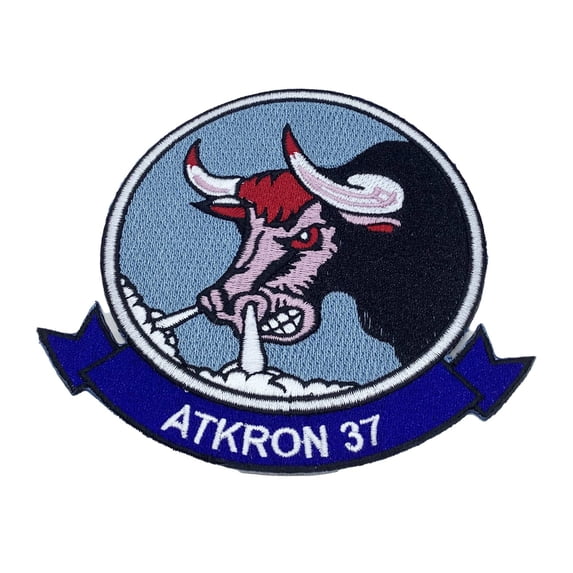
VA-37 Bulls Squadron Patch – No Hook and Loop
A 4″ inch No Hook and Loop patch of the VA-37 Bulls.
1960s
Early insignia.
VA-37 was established as an A-7 Corsair II squadron on July 1, 1966. After training with VA-174 in the operation of the A-7 Corsair II from Jul–Nov 1967, VA-37 became operational in 1967, deploying aboard the USS Kitty Hawk.
1970s
A VA-37 A-7A landing aboard USS Saratoga off Vietnam, in 1972.
In Sep 1970, VA-37 was embarked on USS Saratoga (CV-60) when fighting erupted between Palestinian forces and the Jordanian Army, and was directed to operate in the eastern Mediterranean in response to this crisis. On 29 Sep 1970, VA-37 participated in an air power demonstration for President Richard Nixon during his two-day visit to Saratoga while she steamed in the Med. From June to October 1971, VA-37 participated in the test and evaluation of the new CV concept during the Saratoga’s deployment to the North Atlantic and the Mediterranean Sea. The CV concept involved combining the capabilities of the attack and antisubmarine carriers (CVA and CVS) into a single ship.
The Bulls deployed twice to Yankee Station in support of combat operations during the Vietnam War. On 1 Aug 1972, a Bull A-7A Corsair II was used to establish a sonobuoy field in an anchorage area near the island of Hon Nieu, off the coast of North Vietnam – the first time an A-7 had ever been used to drop sonobuoys.
In 1973, the squadron received their first A-7E, a more advanced version of the plane. They made seven cruises with this plane in the 1970s and early 1980s, including responding to regional crises in the Mediterranean Sea and Indian Ocean.
1980s
On 4 January USS John F. Kennedy (CV-67), with VA-37 embarked as part of Carrier Air Wing Three (AC), deployed from Norfolk VA for a seven-month cruise that saw USS John F. Kennedy sail to the Arabian Sea via the Mediterranean Sea and Suez Canal. During this time port visits took place in St. Thomas, US Virgin Islands, and Malaga, Spain. During their time operating in the Arabian Sea VA-37 and USS John F. Kennedy conducted port visits at Perth, Australia and Mombasa, Kenya, before, in June 1982, USS John F. Kennedy (CV-67),took station off the coast of Lebanon after Israel invaded that country. After leaving the area another port visit took place in Toulon, France, before returning home on 14 July 1982
From 1 October 1982 VA-37 became part of Carrier Air Wing Fifteen (NL) and in January 1983 as part of CVW-15 they embarked on board the (then) newest carrier in the USN, USS Carl Vinson (CVN-70).
VA-37 headed to Naval Air Station Roosevelt Roads in Puerto Rico in August 1942 for exercises with the destroyer USS Mahan (DDG-42), which was the test platform for the development of the CG/SM-2 (ER) missile program project.
On 1 March VA-37 sailed with CVW-15 and USS Carl Vinson on an eight-month would cruise that saw them operate in the Mediterranean Sea, Atlantic Ocean, Indian Ocean, Arabian Sea, South China Sea, and Pacific Ocean in a multitude of exercises and with port visits in Monte Carlo, Monaco, Casablanca, Morocco, Abidjan, Ivory Coast, Perth, Australia, Subic Bay, Philippines, Hong Kong, Sasebo, Japan, Pusan, Republic of Korea, and Pearl Harbor, Hawaii, before returning to NAS Cecil Field in Florida on 29 October 1983.
In June 1984, the squadron’s primary mission was changed to close air support in preparation for its deployment to MCAS Iwakuni as part of the Marine Corps Unit Deployment Program. The deployment of the two Navy attack squadrons was designed to test the interoperability of the Marine Corps and Navy.
In December 1984, VA-37 deployed to MCAS Iwakuni and relieved VA-105. While deployed to Iwakuni, the squadron was detached to Yechon, Korea, to participate in exercise Team Spirit 85. This was the first time a Navy carrier-based squadron had deployed in field conditions since World War II.
In April 1988, VA-37 deployed with C