
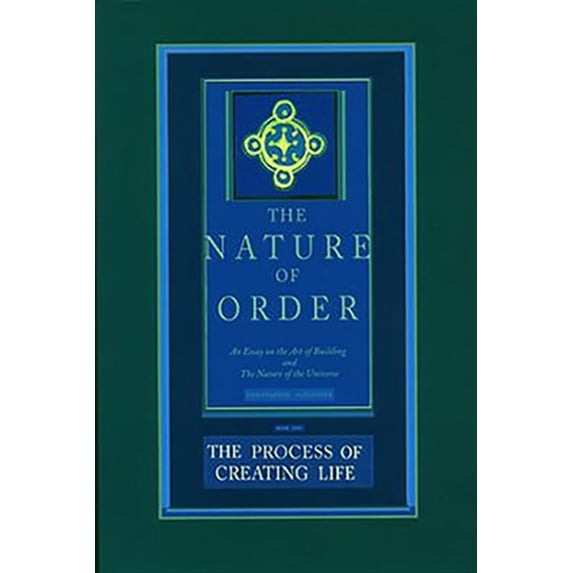
Pre-Owned The Nature of Order, Book Two: The Process of Creating Life : An Essay on the Art of Building and The Nature of the Universe (Hardcover)
Key item features
Scientifically, The Process of Creating Life is perhaps the most exciting of the four books. How do beautiful creations come into being? Nature can make an infinite number of human faces, each one unique, each one beautiful. The same is true for daffodils, streams, and stars. But man-made creations especially the towns and buildings of the 20th century have only occasionally been really good, more often mediocre, and in the last 50 years have most often been deadly. What is the reason for the difference? It hinges on the deep nature of the processes we use. Merely understanding the geometry of beautiful and living form (the topic of Book 1) is not enough to help us create such a living geometry.
In the 20th century our society was locked into deadly processes which created our current built environment, process that most people were not really aware of and did not question. Despite their best efforts and intentions, architects and planners working within these processes could not achieve a living built environment. Life and beauty in the built world arise only from processes which allow living structure to unfold. The secret lies in knowing, as nature does, what must happen in what order: what sequence of events allows a living form to unfold successfully?
Here, in Book 2, Alexander puts forward a fully developed theory of living process. He defines conditions for a process to be living: that is, capable of generating living structure. He shows how such processes work, and how they may be created. At the core of the new theory is the theory of structure-preserving transformations. This concept, new in scientific thinking, is based on the concept of wholeness defined in Book 1: A structure-preserving transformation is one which preserves, extends, and enhances the wholeness of a system.
Structure-preserving transformations provide the means for any step-by-step process social, biological, architectural, or technical to reach configurations which are most profound, most capable of supporting life. The process of creation whether in the formation of a single object, or in the piece-meal aggregation of a town requires this sort of generative process, a careful and deliberate sequence of steps in which each step creates the context for the next one, and each next wholeness is derived from the previous wholeness. Our billions of beautiful and unique human faces come from one class of sequences.
Driven by these sequences, an initial cell differentiates again and again until beautiful and complex human beings emerge, infinitely various, always harmonious. Making changes in society, so that streets, buildings, rooms, gardens, and towns may be generated by hundreds of such sequences requires massive transformations. This book is the first blueprint of those transformations.
Taken as a whole, the four books create a sweeping new conception of the nature of things which is both objective and structural (hence part of science) and also personal (in that it shows how and why things have the power to touch the human heart). A step has been taken, through which these two domains the domain of geometrical structure and the feeling it creates kept separate during four centuries of scientific though from 1600 to 2000, have finally been united.
The Nature of Order constitutes the backbone of Building Beauty: Ecologic Design Construction Process, an initiative aimed at radically reforming architecture education, with the emphasis of making as a way to access a transformative vision of the world. The 15 fundamental properties of life guide our work and have given us much more than a set of solutions. The Nature of Order has given us the framework in which we can search and build up our own solutions.
In order to be authentically sustainable, buildings and places have to be cared for and loved over generations. Beautiful buildings and places are more likely to be loved, and they become more beautiful, and loved, through the attention given to them over time. Beauty is therefore, not a luxury, or an option, it includes and transcends technological innovation, and is a necessary requirement for a truly sustainable culture.
Specs
- Book formatHardcover
- Fiction/nonfictionNon-Fiction
- GenreGeneral Interest
- Pages631
- Series titleNature of Order
- Number in series2
How do you want your item?
About this item
Product details
Scientifically, The Process of Creating Life is perhaps the most exciting of the four books. How do beautiful creations come into being? Nature can make an infinite number of human faces, each one unique, each one beautiful. The same is true for daffodils, streams, and stars. But man-made creations especially the towns and buildings of the 20th century have only occasionally been really good, more often mediocre, and in the last 50 years have most often been deadly. What is the reason for the difference? It hinges on the deep nature of the processes we use. Merely understanding the geometry of beautiful and living form (the topic of Book 1) is not enough to help us create such a living geometry.
In the 20th century our society was locked into deadly processes which created our current built environment, process that most people were not really aware of and did not question. Despite their best efforts and intentions, architects and planners working within these processes could not achieve a living built environment. Life and beauty in the built world arise only from processes which allow living structure to unfold. The secret lies in knowing, as nature does, what must happen in what order: what sequence of events allows a living form to unfold successfully?
Here, in Book 2, Alexander puts forward a fully developed theory of living process. He defines conditions for a process to be living: that is, capable of generating living structure. He shows how such processes work, and how they may be created. At the core of the new theory is the theory of structure-preserving transformations. This concept, new in scientific thinking, is based on the concept of wholeness defined in Book 1: A structure-preserving transformation is one which preserves, extends, and enhances the wholeness of a system.
Structure-preserving transformations provide the means for any step-by-step process social, biological, architectural, or technical to reach configurations which are most profound, most capable of supporting life. The process of creation whether in the formation of a single object, or in the piece-meal aggregation of a town requires this sort of generative process, a careful and deliberate sequence of steps in which each step creates the context for the next one, and each next wholeness is derived from the previous wholeness. Our billions of beautiful and unique human faces come from one class of sequences.
Driven by these sequences, an initial cell differentiates again and again until beautiful and complex human beings emerge, infinitely various, always harmonious. Making changes in society, so that streets, buildings, rooms, gardens, and towns may be generated by hundreds of such sequences requires massive transformations. This book is the first blueprint of those transformations.
Taken as a whole, the four books create a sweeping new conception of the nature of things which is both objective and structural (hence part of science) and also personal (in that it shows how and why things have the power to touch the human heart). A step has been taken, through which these two domains the domain of geometrical structure and the feeling it creates kept separate during four centuries of scientific though from 1600 to 2000, have finally been united.
The Nature of Order constitutes the backbone of Building Beauty: Ecologic Design Construction Process, an initiative aimed at radically reforming architecture education, with the emphasis of making as a way to access a transformative vision of the world. The 15 fundamental properties of life guide our work and have given us much more than a set of solutions. The Nature of Order has given us the framework in which we can search and build up our own solutions.
In order to be authentically sustainable, buildings and places have to be cared for and loved over generations. Beautiful buildings and places are more likely to be loved, and they become more beautiful, and loved, through the attention given to them over time. Beauty is therefore, not a luxury, or an option, it includes and transcends technological innovation, and is a necessary requirement for a truly sustainable culture.
What is Pre-Owned: Like New?
What is the Walmart Pre-Owned Program?
Walmart Pre-Owned allows you to find previously owned, well-cared-for items from Walmart’s trusted & performance-managed sellers. Shopping Pre-Owned allows you to bring home the best-quality picks at even lower prices, in addition to extending the life of an item & reducing waste. Find your favorites & shop a range of conditions in every category.
Why Walmart Pre-Owned?
Trusted sellers & quality items
Each Pre-Owned item listed comes from Walmart’s trusted performance-managed sellers, to ensure you get quality items.

Quality you can afford
Save even more on top brands & your most-loved items.

30-day free returns
Don’t love it? Most items offer a 30-day* free return policy, for added peace of mind.
Sustainability
Shopping Pre-Owned helps in extending the life of an item & reducing waste.
Product image for illustration purposes only. The item you receive may vary from the image in minor ways, such as slight differences in appearance, color, and/or design. *Exceptions apply during holiday season, and on certain electronics, collectibles, and jewelry.
Pre-Owned: Like New
What is the Walmart Pre-Owned Program?
Walmart Pre-Owned allows you to find previously owned, well-cared-for items from Walmart’s trusted & performance-managed sellers. Shopping Pre-Owned allows you to bring home the best-quality picks at even lower prices, in addition to extending the life of an item & reducing waste. Find your favorites & shop a range of conditions in every category.
Why Walmart Pre-Owned?

Trusted sellers & quality items
Each Pre-Owned item listed comes from Walmart’s trusted performance-managed sellers, to ensure you get quality items.
Quality you can afford
Save even more on top brands & your most-loved items.

30-day free returns
Don’t love it? Most items offer a 30-day* free return policy, for added peace of mind.

Sustainability
Shopping Pre-Owned helps in extending the life of an item & reducing waste.
Product image for illustration purposes only. The item you receive may vary from the image in minor ways, such as slight differences in appearance, color, and/or design. *Exceptions apply during holiday season, and on certain electronics, collectibles, and jewelry.
