

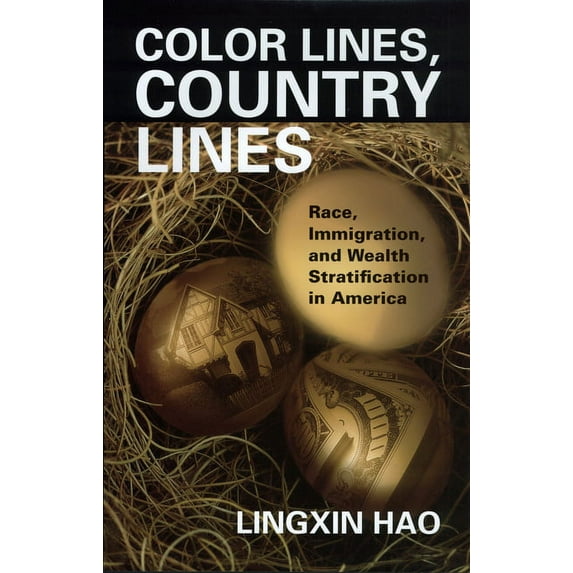
Hero image 0 of Color Lines, Country Lines : Race, Immigration, and Wealth Stratification in America (Paperback), 0 of 1
Color Lines, Country Lines : Race, Immigration, and Wealth Stratification in America (Paperback)
(No ratings yet)
Key item features
The growing number of immigrants living and working in America has become a controversial topic from classrooms to corporations and from kitchen tables to Capitol Hill. Many native-born Americans fear that competition from new arrivals will undermine the economic standing of low-skilled American workers, and that immigrants may not successfully integrate into the U.S. economy. In Color Lines, Country Lines, sociologist Lingxin Hao argues that the current influx of immigrants is changing America's class structure, but not in the ways commonly believed. Drawing on twenty years of national survey data, Color Lines, Country Lines investigates how immigrants are faring as they try to accumulate enough wealth to join the American middle class, and how, in the process, they are transforming historic links between race and socioeconomic status. Hao finds that disparities in wealth among immigrants are large and growing, including disparities among immigrants of the same race or ethnicity. Cuban immigrants have made substantially more progress than arrivals from the Dominican Republic, Chinese immigrants have had more success than Vietnamese or Korean immigrants, and Jamaicans have fared better than Haitians and immigrants from sub-Saharan Africa. Indeed, many of these immigrant groups have acquired more wealth than native-born Americans of the same race or ethnicity. Hao traces these diverging paths to differences in the political and educational systems of the immigrants' home countries, as well as to preferential treatment of some groups by U.S. immigration authorities and the U.S. labor market. As a result, individuals' country of origin increasingly matters more than their race in determining their prospects for acquiring wealth. In a novel analysis, Hao predicts that as large numbers of immigrants arrive in the United States every year, the variation in wealth within racial groups will continue to grow, reducing wealth inequalities between racial groups. If upward mobility remains restricted to only some groups, then the old divisions of wealth by race will gradually become secondary to new disparities based on country of origin. However, if the labor market and the government are receptive to all immigrant groups, then the assimilation of immigrants into the middle class will help diminish wealth inequality in society as a whole. Immigrants' assimilation into the American mainstream and the impact of immigration on the American economy are inextricably linked, and each issue can only be understood in light of the other. Color Lines, Country Lines shows why some immigrant groups are struggling to get by while others have managed to achieve the American dream and reveals the surprising ways in which immigration is reshaping American society.
Specs
- Book formatPaperback
- Fiction/nonfictionNon-Fiction
- GenreNonfiction
- Publication dateFebruary, 2010
- Pages326
- EditionIllustrated
Current price is USD$41.04
Price when purchased online
- Free shipping
 Free 30-day returns
How do you want your item?
Columbus, 43215
Arrives between May 8 - May 13
|
Sold and shipped by newbookdeals
4.5602910602910605 stars out of 5, based on 1924 seller reviews(4.6)1924 seller reviews

Free 30-day returns - in store or online
About this item
Product details
The growing number of immigrants living and working in America has become a controversial topic from classrooms to corporations and from kitchen tables to Capitol Hill. Many native-born Americans fear that competition from new arrivals will undermine the economic standing of low-skilled American workers, and that immigrants may not successfully integrate into the U.S. economy. In Color Lines, Country Lines, sociologist Lingxin Hao argues that the current influx of immigrants is changing America's class structure, but not in the ways commonly believed. Drawing on twenty years of national survey data, Color Lines, Country Lines investigates how immigrants are faring as they try to accumulate enough wealth to join the American middle class, and how, in the process, they are transforming historic links between race and socioeconomic status. Hao finds that disparities in wealth among immigrants are large and growing, including disparities among immigrants of the same race or ethnicity. Cuban immigrants have made substantially more progress than arrivals from the Dominican Republic, Chinese immigrants have had more success than Vietnamese or Korean immigrants, and Jamaicans have fared better than Haitians and immigrants from sub-Saharan Africa. Indeed, many of these immigrant groups have acquired more wealth than native-born Americans of the same race or ethnicity. Hao traces these diverging paths to differences in the political and educational systems of the immigrants' home countries, as well as to preferential treatment of some groups by U.S. immigration authorities and the U.S. labor market. As a result, individuals' country of origin increasingly matters more than their race in determining their prospects for acquiring wealth. In a novel analysis, Hao predicts that as large numbers of immigrants arrive in the United States every year, the variation in wealth within racial groups will continue to grow, reducing wealth inequalities between racial groups. If upward mobility remains restricted to only some groups, then the old divisions of wealth by race will gradually become secondary to new disparities based on country of origin. However, if the labor market and the government are receptive to all immigrant groups, then the assimilation of immigrants into the middle class will help diminish wealth inequality in society as a whole. Immigrants' assimilation into the American mainstream and the impact of immigration on the American economy are inextricably linked, and each issue can only be understood in light of the other. Color Lines, Country Lines shows why some immigrant groups are struggling to get by while others have managed to achieve the American dream and reveals the surprising ways in which immigration is reshaping American society.
The growing number of immigrants living and working in America has become a controversial topic from classrooms to corporations and from kitchen tables to Capitol Hill. Many native-born Americans fear that competition from new arrivals will undermine the economic standing of low-skilled American workers, and that immigrants may not successfully integrate into the U.S. economy. In Color Lines, Country Lines, sociologist Lingxin Hao argues that the current influx of immigrants is changing America's class structure, but not in the ways commonly believed. Drawing on twenty years of national survey data, Color Lines, Country Lines investigates how immigrants are faring as they try to accumulate enough wealth to join the American middle class, and how, in the process, they are transforming historic links between race and socioeconomic status. Hao finds that disparities in wealth among immigrants are large and growing, including disparities among immigrants of the same race or ethnicity. Cuban immigrants have made substantially more progress than arrivals from the Dominican Republic, Chinese immigrants have had more success than Vietnamese or Korean immigrants, and Jamaicans have fared better than Haitians and immigrants from sub-Saharan Africa. Indeed, many of these immigrant groups have acquired more wealth than native-born Americans of the same race or ethnicity. Hao traces these diverging paths to differences in the political and educational systems of the immigrants' home countries, as well as to preferential treatment of some groups by U.S. immigration authorities and the U.S. labor market. As a result, individuals' country of origin increasingly matters more than their race in determining their prospects for acquiring wealth. In a novel analysis, Hao predicts that as large numbers of immigrants arrive in the United States every year, the variation in wealth within racial groups will continue to grow, reducing wealth inequalities between racial groups. If upward mobility remains restricted to only some groups, then the old divisions of wealth by race will gradually become secondary to new disparities based on country of origin. However, if the labor market and the government are receptive to all immigrant groups, then the assimilation of immigrants into the middle class will help diminish wealth inequality in society as a whole. Immigrants' assimilation into the American mainstream and the impact of immigration on the American economy are inextricably linked, and each issue can only be understood in light of the other. Color Lines, Country Lines shows why some immigrant groups are struggling to get by while others have managed to achieve the American dream and reveals the surprising ways in which immigration is reshaping American society.
info:
We aim to show you accurate product information. Manufacturers, suppliers and others provide what you see here, and we have not verified it.
Specifications
Book format
Paperback
Fiction/nonfiction
Non-Fiction
Genre
Nonfiction
Publication date
February, 2010
Warranty
Warranty information
Please be aware that the warranty terms on items offered for sale by third party Marketplace sellers may differ from those displayed in this section (if any). To confirm warranty terms on an item offered for sale by a third party Marketplace seller, please use the 'Contact seller' feature on the third party Marketplace seller's information page and request the item's warranty terms prior to purchase.
Similar items you might like
Based on what customers bought
On Decoloniality White Enclosures: Racial Capitalism and Coloniality Along the Balkan Route, (Paperback) $27.93
 $2793current price $27.93
On Decoloniality White Enclosures: Racial Capitalism and Coloniality Along the Balkan Route, (Paperback)
Latin America Otherwise Black Nationalism in the New World: Reading the African-American and West Indian Experience, (Paperback) $34.45
 $3445current price $34.45
Latin America Otherwise Black Nationalism in the New World: Reading the African-American and West Indian Experience, (Paperback)
Bodies Politic: Negotiating Race in the American North, 1730-1830, (Paperback) $37.02
 $3702current price $37.02
Bodies Politic: Negotiating Race in the American North, 1730-1830, (Paperback)
Multimodal Funds of Knowledge in Literacy: Countering Deficit Narratives of Diverse Families, (Paperback) $42.39
 $4239current price $42.39
Multimodal Funds of Knowledge in Literacy: Countering Deficit Narratives of Diverse Families, (Paperback)
Immigration and Categorical Inequality: Migration to the City and the Birth of Race and Ethnicity, (Paperback) $56.14
 $5614current price $56.14
Immigration and Categorical Inequality: Migration to the City and the Birth of Race and Ethnicity, (Paperback)
Contributions in Afro-American and Afric The Wealth of Races: The Present Value of Benefits from Past Injustices, (Paperback) $39.95
 $3995current price $39.95
Contributions in Afro-American and Afric The Wealth of Races: The Present Value of Benefits from Past Injustices, (Paperback)
Antinomies of Modernity: Essays on Race, Orient, Nation, (Paperback) $44.29
 $4429current price $44.29
Antinomies of Modernity: Essays on Race, Orient, Nation, (Paperback)
From Manila to Wall Street: An Immigrant's Journey With America's First Black Tycoon, (Hardcover) $26.75
 $2675current price $26.75
From Manila to Wall Street: An Immigrant's Journey With America's First Black Tycoon, (Hardcover)
Best seller Black AF History: The un-Whitewashed Story of America (Hardcover) $20.99 Was $32.50
Best seller $2099current price $20.99, Was $32.50$32.50
Black AF History: The un-Whitewashed Story of America (Hardcover)
1444.7 out of 5 Stars. 144 reviewsEssor des Pays Pauvres face à la Mondialisation du Numérique, (Paperback) $49.00
 $4900current price $49.00
Essor des Pays Pauvres face à la Mondialisation du Numérique, (Paperback)
American Campus Black Space: Negotiating Race, Diversity, and Belonging in the Ivory Tower, (Paperback) $36.78
 $3678current price $36.78
American Campus Black Space: Negotiating Race, Diversity, and Belonging in the Ivory Tower, (Paperback)
Rutgers Studies on Race and Ethnicity Katrina's Imprint: Race and Vulnerability in America, (Paperback) $43.69
 $4369current price $43.69
Rutgers Studies on Race and Ethnicity Katrina's Imprint: Race and Vulnerability in America, (Paperback)
Best seller The Psychology of Money: Timeless Lessons on Wealth, Greed, and Happiness (Paperback) $10.99 Was $14.99
Best seller $1099current price $10.99, Was $14.99$14.99
The Psychology of Money: Timeless Lessons on Wealth, Greed, and Happiness (Paperback)
1404.5 out of 5 Stars. 140 reviewsFrom Manila to Wall Street: An Immigrant's Journey With America's First Black Tycoon, (Paperback) $20.00
 $2000current price $20.00
From Manila to Wall Street: An Immigrant's Journey With America's First Black Tycoon, (Paperback)
Black Men, Intergenerational Colonialism, and Behavioral Health: A Noose Across Nations, (Paperback) $27.96
 $2796current price $27.96
Black Men, Intergenerational Colonialism, and Behavioral Health: A Noose Across Nations, (Paperback)
Fifteen Cents on the Dollar: How Americans Made the Black-White Wealth Gap, (Hardcover) $11.64
 $1164current price $11.64
Fifteen Cents on the Dollar: How Americans Made the Black-White Wealth Gap, (Hardcover)
Straddling the Border: Immigration Policy and the Ins, (Paperback) $26.32
 $2632current price $26.32
Straddling the Border: Immigration Policy and the Ins, (Paperback)
Race in the Atlantic World Wanted! a Nation!: Black Americans and Haiti, 1804-1893, (Paperback) $24.25
 $2425current price $24.25
Race in the Atlantic World Wanted! a Nation!: Black Americans and Haiti, 1804-1893, (Paperback)
Capitalism and Its Challenges Across Borders : Perspectives from the Asian, African and American Continents (Paperback) $29.80
 $2980current price $29.80
Capitalism and Its Challenges Across Borders : Perspectives from the Asian, African and American Continents (Paperback)
An Essay on the Origin, Habits, &c. of The African Race (Paperback) $15.95
 $1595current price $15.95
An Essay on the Origin, Habits, &c. of The African Race (Paperback)
Customer ratings & reviews
0 ratings|0 reviews
This item does not have any reviews yet
