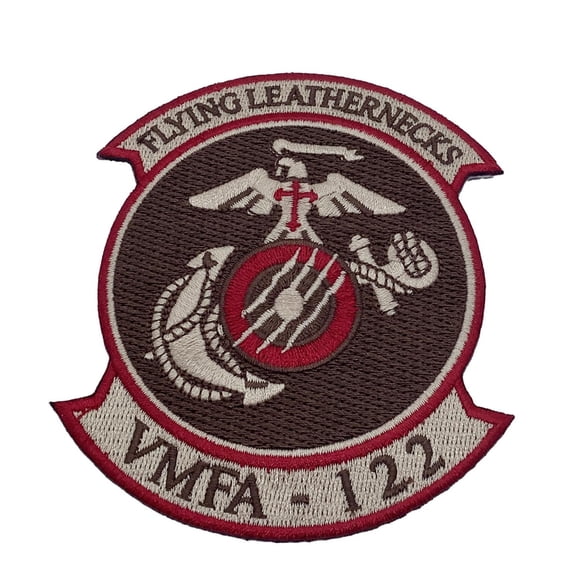
VMFA-122 Flying Leathernecks Desert Tan Patch – With Hook and Loop
A 4″ With Hook and Loop Squadron Patch of the VMFA-122 Flying Leathernecks.
- 4″ inches
- With Hook and Loop
- US Veteran Owned Business
World War II
Marine Fighter Squadron 122 (VMF-122) was commissioned on March 1, 1942 at Camp Kearny in San Diego, California. Outfitted with the F4F Wildcat, the squadron, then known as the “Candystripers”, saw their first combat tour in October 1942. During this tour they were part of the Cactus Air Force at Henderson Field and also operated out of Espiritu Santo. In April 1943, while under the command of Major Pappy Boyington, the squadron transitioned to the F4U Corsair and accounted for 35½ kills. The squadron’s first combat tour ended on July 23, 1943 after which they returned to Marine Corps Air Station Miramar on August 16. For the next year after their return to the States, the squadron was reorganized and retrained at Marine Corps Air Station El Centro, California.
For its second tour, VMF-122’s flight echelon embarked upon the escort carrier USS Hollandia in July 1944 while the ground echelon steamed out on the USS Tryon. Beginning in October 1944 both echelons would be reunited when they were reunited and began operating from an airstrip on Peleliu. At times they provided close air support for Marines during the Battle of Peleliu at distances of just over 1000 yards from where they took off. The squadrons ability to provide napalm and rockets, both new weapons systems, greatly aided in the destruction of the last Japanese strongholds on the island.[2] For the remainder of the war they remained on the island conducting combat operations until August 1945.
Following the surrender of Japan, VMF-122 returned home to Marine Corps Auxiliary Air Station Oak Grove, North Carolina in January 1946. They remained there for less than two years before being moved to MCAS Beaufort which was followed by another move to Marine Corps Air Station Cherry Point, North Carolina.
1950s
The squadron was reactivated in November 1947, flying the FH Phantom, becoming the first Marine squadron to employ jet-propelled aircraft. During this time, the squadron also fielded the first and only Marine aerial demonstration team known as the “Flying Leathernecks”. They toured the country for two years before being disbanded with the transition to the F2H Banshee. In April 1951, the squadron became the first Marine jet squadron to be both day and night qualified for carrier operations. On 15 May 1951, the squadron deployed from Naval Air Station Quonset Point aboard the USS Oriskany to the Mediterranean Sea, returning to the Marine Corps Air Station, Cherry Point in early October 1951. In 1952, they again transitioned to the F9F Panther and after a Mediterranean cruise in 1953, they were assigned to Marine Aircraft Group 24 at MCAS Cherry Point.
January 1954 again saw the squadron transitioning aircraft, this time to the FJ Fury. The next few years saw a litany of small deployments on board a multitude of aircraft carriers. The squadron relocated to Marine Corps Air Station Beaufort in September 1957 and in December of that year they became the first squadron in the Marine Corps to fly the F-8 Crusader. It was at this time that they transitioned from being the “Candystripers” to the new nickname of “Crusaders.” The squadron became VMF(AW)-122 upon receiving all weather capable F-8Es in 1962. That year they also deployed to Key West, Florida to fly combat air patrol during the Cuban missile crisis.
Vietnam War
In 1964, VMF(AW)-122 deployed to Naval Air Facility Atsugi for a year and returned to Marine Corps Air Station El Toro in January 1965. While at MCAS El Toro they transitioned to the F-4B Phantom and were redesignated VMFA-122. They deployed to the Republic of Vietnam in August 1967 and operated from Da Nang Air