

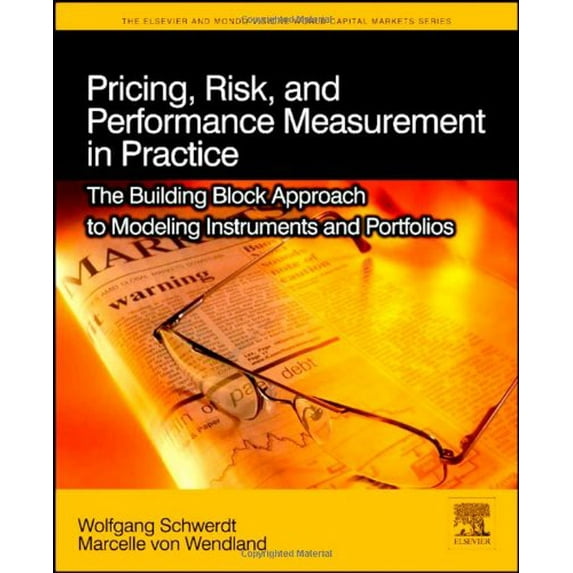
PRICING, RISK, AND PERFORMANCE MEASUREMENT IN PRACTICE
(No ratings yet)
Key item features
Financial models and portfolios are only as good as the software-based representations of them, and this book is the first to bridge the gap between the theory of financial pricing, risk and performance measurement and modeling, and actually implementing all this in a your firm's software systems. The authors are the developers of the European Central Bank's (ECB) standard for the description of financial instruments. The ECB has adopted this approach because it is an extremely flexible, innovative, yet logically simple and consistent way to accurately define and set up even very large numbers of financial instruments, and because it simplifies the valuation, risk and performance measurement process. This is because it standardizes and breaks up the calculation task into simpler subtasks, thus preparing the way for a faster road to improvements in speed and accuracy. This is the only book that explains the new ECB standard, and provides clear and consistent worked examples and programming code throughout the book to demonstrate to the reader how to use the standard to build financial instruments in software systems, then how to price them, and then how to measure the risk and performance of the portfolios that comprise them. The aim of this book is to introduce the reader to a practical approach for pricing a broad range of financial instruments and analysing the risk and performance of simple and complex portfolios. Carefully chosen worked examples will allow the reader to gain confidence in using securities and derivatives pricing models and risk and performance measurement methods commonly used in today?s risk and portfolio management practice. Its practical focus, systematic step by step approach and fully up to date coverage of pricing, risk and performance measurement analytics will set this book apart from competing publications and fill a growing need for a practical introduction to financial engineering and risk and performance measurement. The key value proposition for this book is that it is based on the authors? experience of designing and implementing valuation, risk measurement, and performance measurement solutions, and in particular developing and implementing the European Central Bank?s (ECB) standard for the description of financial instruments. The book will thus help the reader bridge the gap from understanding pricing, risk and performance measurement models to their practical implementation in software based solutions. The book introduces the reader to an approach developed by the authors while working for the European Central Bank. It allows to price and analyse any instrument in terms of a limited set of atomic instruments. The pricing and risk relevant characteristics of any financial instrument can thus be decomposed into those of a small set of atomic instruments that represent the given instrument well. The instrument can then be priced and performance and risk analytics for it can be calculated using well known robust models utilizing readily available information. This approach allows the reader to overcome the situation of having to master a myriad of specific instrument variants and their pricing and risk measurement models, by being able to make reference to a single framework. This approach was selected first because it is an extremely flexible, innovative and yet logically simple and consistent way to accurately define and set up even very large numbers of financial instruments of every description from simple to complex and from traditional to one-off and just invented, and second because it simplifies the valuation, risk and performance measurement calculation process. This is because it standardizes and breaks up the calculation task into simpler subtasks thus preparing the way for a faster road to improvements in speed and accuracy. The book then builds on this with further guidance, telling the reader what is relevant and what not, and
Specs
- Book formatHardcover
- Fiction/nonfictionNon-Fiction
- GenreBusiness & Investing
- Pages300
- Reading levelScholarly & Professional
- Edition1
Price when purchased online
Not Available
How do you want your item?
Not available
About this item
Product details
PRICING, RISK, AND PERFORMANCE MEASUREMENT IN PRACTICE
Financial models and portfolios are only as good as the software-based representations of them, and this book is the first to bridge the gap between the theory of financial pricing, risk and performance measurement and modeling, and actually implementing all this in a your firm's software systems. The authors are the developers of the European Central Bank's (ECB) standard for the description of financial instruments. The ECB has adopted this approach because it is an extremely flexible, innovative, yet logically simple and consistent way to accurately define and set up even very large numbers of financial instruments, and because it simplifies the valuation, risk and performance measurement process. This is because it standardizes and breaks up the calculation task into simpler subtasks, thus preparing the way for a faster road to improvements in speed and accuracy. This is the only book that explains the new ECB standard, and provides clear and consistent worked examples and programming code throughout the book to demonstrate to the reader how to use the standard to build financial instruments in software systems, then how to price them, and then how to measure the risk and performance of the portfolios that comprise them. The aim of this book is to introduce the reader to a practical approach for pricing a broad range of financial instruments and analysing the risk and performance of simple and complex portfolios. Carefully chosen worked examples will allow the reader to gain confidence in using securities and derivatives pricing models and risk and performance measurement methods commonly used in today?s risk and portfolio management practice. Its practical focus, systematic step by step approach and fully up to date coverage of pricing, risk and performance measurement analytics will set this book apart from competing publications and fill a growing need for a practical introduction to financial engineering and risk and performance measurement. The key value proposition for this book is that it is based on the authors? experience of designing and implementing valuation, risk measurement, and performance measurement solutions, and in particular developing and implementing the European Central Bank?s (ECB) standard for the description of financial instruments. The book will thus help the reader bridge the gap from understanding pricing, risk and performance measurement models to their practical implementation in software based solutions. The book introduces the reader to an approach developed by the authors while working for the European Central Bank. It allows to price and analyse any instrument in terms of a limited set of atomic instruments. The pricing and risk relevant characteristics of any financial instrument can thus be decomposed into those of a small set of atomic instruments that represent the given instrument well. The instrument can then be priced and performance and risk analytics for it can be calculated using well known robust models utilizing readily available information. This approach allows the reader to overcome the situation of having to master a myriad of specific instrument variants and their pricing and risk measurement models, by being able to make reference to a single framework. This approach was selected first because it is an extremely flexible, innovative and yet logically simple and consistent way to accurately define and set up even very large numbers of financial instruments of every description from simple to complex and from traditional to one-off and just invented, and second because it simplifies the valuation, risk and performance measurement calculation process. This is because it standardizes and breaks up the calculation task into simpler subtasks thus preparing the way for a faster road to improvements in speed and accuracy. The book then builds on this with further guidance, telling the reader what is relevant and what not, and
info:
We aim to show you accurate product information. Manufacturers, suppliers and others provide what you see here, and we have not verified it.
Specifications
Language
English
Series Title
The Elsevier and Mondo Visione World Capital Markets
Publisher
Academic Press
Book Format
Hardcover
Customer ratings & reviews
0 ratings|0 reviews
This item does not have any reviews yet

Related pages
- Natural Resource Extraction Industry Books
- Bloombergbusiness
- Options Commodities
- Food Industry Industry Books
- General Commodities in Investments & Securities Books
- Energy Commodities in Investments & Securities Books
- Consumption
- Measured Services
- Metals Commodities in Investments & Securities Books
- Agribusiness Industry Books
- Fed E Tracking
- Consumption Economy