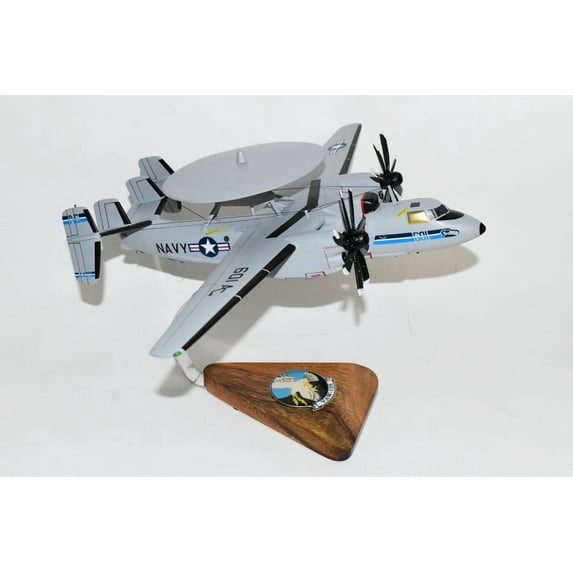
VAW-126 Seahawks E-2C Model Fly with VAW-126 Seahawks in this handcrafted E-2C with 1973 markings. Each piece is carved from wood and handpainted to provide a piece you'll love. Length - 13.5 inches Made from Mahogany US Veteran Owned Business The product is not intended to be used by children 12 years and younger. Carrier Airborne Early Warning Squadron ONE TWO SIX (VAW-126), nicknamed the SEAHAWKS, is an integral part of the tactical air forces of the United States Navy. VAW-126 is one of six Carrier Airborne Early Warning Squadrons based in Norfolk. Equipped with five E-2D Advanced Hawkeye aircraft, the squadron's primary mission is airborne command and control in support of Joint Warfare Commanders. VAW-126 implements command and control through diverse operations such as air intercept control, strike control, surface search and coordination, search and rescue coordination, and airborne battlefield command and control. VAW-126 was commissioned in Norfolk, Virginia on April 1st, 1969. Equipped with four E-2A Hawkeye aircraft, the squadron was assigned to Attack Carrier Air Wing SEVENTEEN (CVW-17) assigned to USS FORRESTAL (CV 59). Following completion of their first deployment in July 1970, the squadron transitioned to the E-2B. This was a newer version of the same aircraft, equipped with a more flexible, digital computer weapons system. The command received accolades early in its history, winning the highly coveted COMNAVAIRLANT Battle Readiness Efficiency "E" and the CNO Safety “S” Award in 1971. The squadron won the Battle "E" a second time in 1974. While homeward bound from a Mediterranean deployment in September 1974, the squadron performed a crossdeck to USS AMERICA (CV 66). The NATO deployment marked VAW-126's final E-2B flying as well. Following their return to Norfolk in October 1974, the squadron began its transition to the E-2C, Group 0 variant; an aircraft similar in appearance to its predecessor, but with a significantly more capable and reliable weapon system. In August 1975, the squadron commenced operations in the Caribbean Sea with CVW-9, based at NAS Miramar, California. In May 1976, they began the first of many trips moving the entire squadron back and forth between Norfolk and Miramar to operate with CVW-9 and prepare for their upcoming deployment aboard USS CONSTELLATION (CV 64). The squadron made two Western Pacific deployments with USS CONSTELLATION, their final one was in May 1978. The SEAHAWKS joined USS JOHN F. KENNEDY (CV 67) and CVW-1 upon returning to the East coast in 1979. In August 1980 the SEAHAWKS would once again find themselves in the Mediterranean Sea for an eight month deployment. In July 1981, VAW-126 joined CVW-3, which replaced CVW-1 as the air wing deployed aboard USS JOHN F. KENNEDY (CV 67). As a result of their superior performance on their 1983-84 deployment they would receive the 1983 Battle "E". In addition, the SEAHAWKS received the COMNAVAIRLANT "Silver Anchor" award for superior retention and the Airborne Early Warning Excellence Award as the best VAW squadron in the Navy. The SEAHAWKS departed for the Mediterranean aboard USS JOHN F. KENNEDY (CV 67) a second time in August 1986. Upon their return in March 1987, the SEAHAWKS kept active by participating in a variety of exercises. By November 1987 the squadron was back aboard USS JOHN F. KENNEDY (CV 67) in preparation for their next deployment. 1988 proved to be another outstanding year for the SEAHAWKS. They once again were awarded the COMNAVAIRLANT Battle "E," Meritorious Unit Commendation, and won the CVW-3 and CAEWWING 12 nomination for the Secretary of Defense Maintenance Excellence Award. The SEAHAWKS departed on USS JOHN F. KENNEDY (CV 67) in August for its 4th deployment on board. The SEAHAWKS set sail for their final deployment attached to the USS JOHN F. KENNEDY STRIKE GROUP in August 1990 answering the call for Operation DESERT SHIELD and DESERT STORM. During this eight month