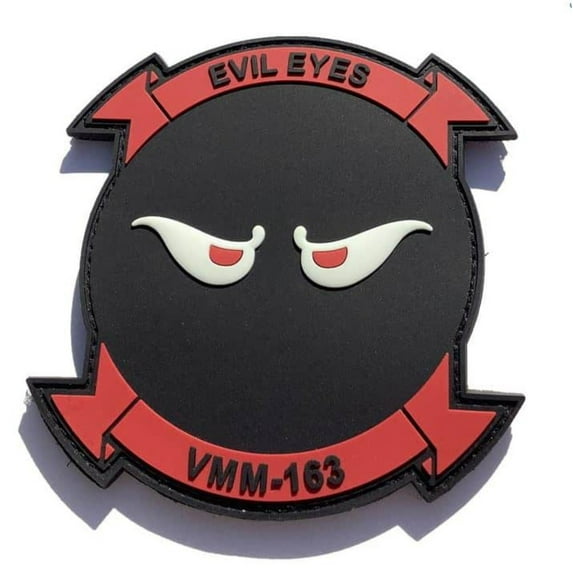
VMM-163 Evil Eyes Glow Eyes PVC Patch – With Hook and Loop
A 4″ inch with Hook and Loop PVC patch of the VMM-163 Evil Eyes Glow Eyes.
HMR(L)-163, the predecessor to HMM-163, was formed in December of 1951. Since that time, its Marines, Sailors and aircraft have flown in continuous support of the United States and Allied operations throughout the Pacific and Central Command Theaters. The name “Ridge Runners” due to a typhoon rescue and relief operations in the mountainous terrain surrounding Hagman, Japan.
From February to October 1965, the HMM-163 “Ridge Runners” helicopter squadron became famous for its operations in Vietnam. It was due to a LIFE magazine story that appeared in the 16 April 1965 issue. The story documented the combat death of a Marine H-34 pilot, 1stLt James E. Magel, and the rescue of wounded and paralyzed 1stLt Dale Eddy during a strike mission transporting South Vietnamese troops. For most U.S. citizens, this was the first time they were made aware of the extent of America’s involvement in Vietnam.
LtCol Charles A. House took the reigns of the squadron in December 1965 at MCAS Futema, Okinawa. With only one month separating HMM-163 from its return deployment to Viet Nam, LtCol House and his veteran pilots determined that a unit symbol was needed to build morale and espirit d’corps, especially for the newly assigned replacement personnel.
Capt Al Barbe, the Squadron Intelligence Officer and husband to a Thai bride, offered a suggestion. Because of Asian culture and beliefs, he proposed that eyes painted on the unit aircraft might have an unsettling effect upon the enemy, thus the concept of “The Eyes” on the front of HMM-163 aircraft was born.
HMM-163 flew via C-130 to Phu Bai, Vietnam, on 1 January 1966 relieved HMM-161 of their H-34 helicopters. Painting of “Genie Eyes” (after the “I Dream of Jeannie” TV show) took hold immediately.
HMM-163’s “Genie Eyes” were being called “Evil Eyes” by the ground units the squadron supported. They flew over 2,000 flight hours in ten days in support of the overrun Ashau Valley Special Forces Camp, in which 190 U.S. Army survivors were rescued from enemy capture. In Aug/Sept 1966, orders came from 1st MAW to eliminate white paint on Marine helicopters; so all white markings and lettering were either stricken or painted over in black. HMM-163 was aboard a carrier off the coast of Vietnam and used the excuse that they were not directly under Wing command at that time. The “Evil Eyes”, therefore, remained black and white.
In October 1966, the squadron again returned to Phu Bai, Viet Nam, still with black and white “Evil Eyes”, under the command of LtCol Rocco Bianchi. LtCol Bianchi was a good friend of the Wing Commander, but that didn’t keep Major General Louis B. Robertshaw, 1st MAW Commanding General, from reading LtCol Bianchi the riot act concerning the unauthorized paint scheme. Also in the room at the time of this conversation was the Commanding General of the Marine ground forces in the area who politely interrupted by saying, “It sure is great to have the ‘Evil Eyes’ back here at Phu Bai!” The 1st MAW Commanding General relented and the “Evil Eyes” have remained to this day.\\
From 1964 to 1968, the squadron served with distinction in combat earning a Presidential Unit Citation and the Navy Unit Commendation along with many personal awards. Since returning to the United States, a vigorous training program designed to produce combat ready CH-46 aircrews has been pursued with many thousands of flight hours flown in support of training. HMM-163 received the Chief of Naval Operations Aviation Safety Award in 1980, 1982, 1983, 1984, 1985, 1989, and 1996, while Five Meritorious Unit Commendations (MUC) for the periods of 1 July 1978 through 31 De