

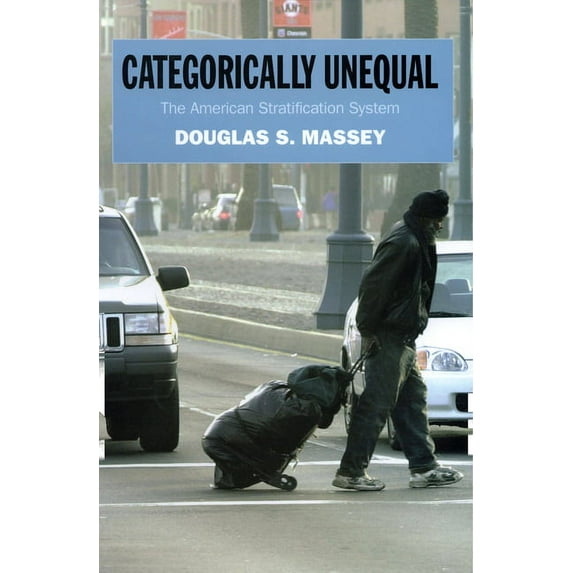
Hero image 0 of Russell Sage Foundation Centennial Series: Categorically Unequal : The American Stratification System (Paperback), 0 of 1
Russell Sage Foundation Centennial Series: Categorically Unequal : The American Stratification System (Paperback)
(No ratings yet)
Key item features
The United States holds the dubious distinction of having the most unequal income distribution of any advanced industrialized nation. While other developed countries face similar challenges from globalization and technological change, none rivals America's singularly poor record for equitably distributing the benefits and burdens of recent economic shifts. In Categorically Unequal, Douglas Massey weaves together history, political economy, and even neuropsychology to provide a comprehensive explanation of how America's culture and political system perpetuates inequalities between different segments of the population. Categorically Unequal is striking both for its theoretical originality and for the breadth of topics it covers. Massey argues that social inequalities arise from the universal human tendency to place others into social categories. In America, ethnic minorities, women, and the poor have consistently been the targets of stereotyping, and as a result, they have been exploited and discriminated against throughout the nation's history. African-Americans continue to face discrimination in markets for jobs, housing, and credit. Meanwhile, the militarization of the U.S.-Mexican border has discouraged Mexican migrants from leaving the United States, creating a pool of exploitable workers who lack the legal rights of citizens. Massey also shows that women's advances in the labor market have been concentrated among the affluent and well-educated, while low-skilled female workers have been relegated to occupations that offer few chances for earnings mobility. At the same time, as the wages of low-income men have fallen, more working-class women are remaining unmarried and raising children on their own. Even as minorities and women continue to face these obstacles, the progressive legacy of the New Deal has come under frontal assault. The government has passed anti-union legislation, made taxes more regressive, allowed the real value of the federal minimum wage to decline, and drastically cut social welfare spending. As a result, the income gap between the richest and poorest has dramatically widened since 1980. Massey attributes these anti-poor policies in part to the increasing segregation of neighborhoods by income, which has insulated the affluent from the social consequences of poverty, and to the disenfranchisement of the poor, as the population of immigrants, prisoners, and ex-felons swells. America's unrivaled disparities are not simply the inevitable result of globalization and technological change. As Massey shows, privileged groups have systematically exploited and excluded many of their fellow Americans. By delving into the root causes of inequality in America, Categorically Unequal provides a compelling argument for the creation of a more equitable society. A Volume in the Russell Sage Foundation's Centennial Series
Specs
- Book formatPaperback
- Fiction/nonfictionNon-Fiction
- Pub date2008-10-16
- Pages340
- Number in series1
- EditionStandard Edition
Current price is USD$27.95
Price when purchased online
Out of stock
How do you want your item?
Out of stock
About this item
Product details
The United States holds the dubious distinction of having the most unequal income distribution of any advanced industrialized nation. While other developed countries face similar challenges from globalization and technological change, none rivals America's singularly poor record for equitably distributing the benefits and burdens of recent economic shifts. In Categorically Unequal, Douglas Massey weaves together history, political economy, and even neuropsychology to provide a comprehensive explanation of how America's culture and political system perpetuates inequalities between different segments of the population. Categorically Unequal is striking both for its theoretical originality and for the breadth of topics it covers. Massey argues that social inequalities arise from the universal human tendency to place others into social categories. In America, ethnic minorities, women, and the poor have consistently been the targets of stereotyping, and as a result, they have been exploited and discriminated against throughout the nation's history. African-Americans continue to face discrimination in markets for jobs, housing, and credit. Meanwhile, the militarization of the U.S.-Mexican border has discouraged Mexican migrants from leaving the United States, creating a pool of exploitable workers who lack the legal rights of citizens. Massey also shows that women's advances in the labor market have been concentrated among the affluent and well-educated, while low-skilled female workers have been relegated to occupations that offer few chances for earnings mobility. At the same time, as the wages of low-income men have fallen, more working-class women are remaining unmarried and raising children on their own. Even as minorities and women continue to face these obstacles, the progressive legacy of the New Deal has come under frontal assault. The government has passed anti-union legislation, made taxes more regressive, allowed the real value of the federal minimum wage to decline, and drastically cut social welfare spending. As a result, the income gap between the richest and poorest has dramatically widened since 1980. Massey attributes these anti-poor policies in part to the increasing segregation of neighborhoods by income, which has insulated the affluent from the social consequences of poverty, and to the disenfranchisement of the poor, as the population of immigrants, prisoners, and ex-felons swells. America's unrivaled disparities are not simply the inevitable result of globalization and technological change. As Massey shows, privileged groups have systematically exploited and excluded many of their fellow Americans. By delving into the root causes of inequality in America, Categorically Unequal provides a compelling argument for the creation of a more equitable society. A Volume in the Russell Sage Foundation's Centennial Series
The United States holds the dubious distinction of having the most unequal income distribution of any advanced industrialized nation. While other developed countries face similar challenges from globalization and technological change, none rivals America's singularly poor record for equitably distributing the benefits and burdens of recent economic shifts. In Categorically Unequal, Douglas Massey weaves together history, political economy, and even neuropsychology to provide a comprehensive explanation of how America's culture and political system perpetuates inequalities between different segments of the population. Categorically Unequal is striking both for its theoretical originality and for the breadth of topics it covers. Massey argues that social inequalities arise from the universal human tendency to place others into social categories. In America, ethnic minorities, women, and the poor have consistently been the targets of stereotyping, and as a result, they have been exploited and discriminated against throughout the nation's history. African-Americans continue to face discrimination in markets for jobs, housing, and credit. Meanwhile, the militarization of the U.S.-Mexican border has discouraged Mexican migrants from leaving the United States, creating a pool of exploitable workers who lack the legal rights of citizens. Massey also shows that women's advances in the labor market have been concentrated among the affluent and well-educated, while low-skilled female workers have been relegated to occupations that offer few chances for earnings mobility. At the same time, as the wages of low-income men have fallen, more working-class women are remaining unmarried and raising children on their own. Even as minorities and women continue to face these obstacles, the progressive legacy of the New Deal has come under frontal assault. The government has passed anti-union legislation, made taxes more regressive, allowed the real value of the federal minimum wage to decline, and drastically cut social welfare spending. As a result, the income gap between the richest and poorest has dramatically widened since 1980. Massey attributes these anti-poor policies in part to the increasing segregation of neighborhoods by income, which has insulated the affluent from the social consequences of poverty, and to the disenfranchisement of the poor, as the population of immigrants, prisoners, and ex-felons swells. America's unrivaled disparities are not simply the inevitable result of globalization and technological change. As Massey shows, privileged groups have systematically exploited and excluded many of their fellow Americans. By delving into the root causes of inequality in America, Categorically Unequal provides a compelling argument for the creation of a more equitable society. A Volume in the Russell Sage Foundation's Centennial Series
info:
We aim to show you accurate product information. Manufacturers, suppliers and others provide what you see here, and we have not verified it.
Specifications
Book format
Paperback
Fiction/nonfiction
Non-Fiction
Genre
Nonfiction, History, Political & Social Sciences
Pub date
2008-10-16
Warranty
Warranty information
Please be aware that the warranty terms on items offered for sale by third party Marketplace sellers may differ from those displayed in this section (if any). To confirm warranty terms on an item offered for sale by a third party Marketplace seller, please use the 'Contact seller' feature on the third party Marketplace seller's information page and request the item's warranty terms prior to purchase.
Similar items you might like
Based on what customers bought
Learning Entrepreneurship Through Indigenous Knowledge (Paperback) $29.86
 $2986current price $29.86
Learning Entrepreneurship Through Indigenous Knowledge (Paperback)
Russell Sage Foundation Centennial Series: America Works : Thoughts on an Exceptional U.S. Labor Market (Paperback) $30.19
 $3019current price $30.19
Russell Sage Foundation Centennial Series: America Works : Thoughts on an Exceptional U.S. Labor Market (Paperback)
Down the Horizon Line: The Working Adventures of Hayes Perkins 1878-1964, (Paperback) $20.42
 $2042current price $20.42
Down the Horizon Line: The Working Adventures of Hayes Perkins 1878-1964, (Paperback)
Surviving Collapse: Building Community Toward Radical Sustainability, (Paperback) $34.96
 $3496current price $34.96
Surviving Collapse: Building Community Toward Radical Sustainability, (Paperback)
Studies in Continental Thought Race and Racism in Continental Philosophy, (Paperback) $28.00
 $2800current price $28.00
Studies in Continental Thought Race and Racism in Continental Philosophy, (Paperback)
Sociology and Social Policy: Essays on Community, Economy, and Society, (Paperback) $28.07
 $2807current price $28.07
Sociology and Social Policy: Essays on Community, Economy, and Society, (Paperback)
Contemporary Societies A Primer on Social Movements, Book 0, (Paperback) $29.47
 $2947current price $29.47
Contemporary Societies A Primer on Social Movements, Book 0, (Paperback)
New Perspectives on the South Industrialization and Southern Society, 1877-1984, (Paperback) $24.93 Was $28.58
 $2493current price $24.93, Was $28.58$28.58
New Perspectives on the South Industrialization and Southern Society, 1877-1984, (Paperback)
Late Nineteenth-Century American Development: A General Equilibrium History, (Paperback) $50.00
 $5000current price $50.00
Late Nineteenth-Century American Development: A General Equilibrium History, (Paperback)
Falling from Grace: Downward Mobility in the Age of Affluence, (Paperback) $25.97
 $2597current price $25.97
Falling from Grace: Downward Mobility in the Age of Affluence, (Paperback)
Norman Street: Poverty and Politics in an Urban Neighborhood (Updated), (Paperback) $23.84
 $2384current price $23.84
Norman Street: Poverty and Politics in an Urban Neighborhood (Updated), (Paperback)
Empirical Research and Normative Theory: Transdisciplinary Perspectives on Two Methodical Traditions Between Separation , (Paperback) $26.65
 $2665current price $26.65
Empirical Research and Normative Theory: Transdisciplinary Perspectives on Two Methodical Traditions Between Separation , (Paperback)
European Foundations of the Welfare State, (Paperback) $44.70
 $4470current price $44.70
European Foundations of the Welfare State, (Paperback)
Searching for the Spirit of American Democracy: Max Weber's Analysis of a Unique Political Culture, Past, Present, and F, (Paperback) $27.40
 $2740current price $27.40
Searching for the Spirit of American Democracy: Max Weber's Analysis of a Unique Political Culture, Past, Present, and F, (Paperback)
Russell Sage Foundation Co-Pub Unequal Democracy: The Political Economy of the New Gilded Age - Second Edition, (Hardcover) $30.04
 $3004current price $30.04
Russell Sage Foundation Co-Pub Unequal Democracy: The Political Economy of the New Gilded Age - Second Edition, (Hardcover)
California Series on Social Choice and Political Economy: Principles of Group Solidarity (Series #11) (Edition 1) (Paperback) $38.80
 $3880current price $38.80
California Series on Social Choice and Political Economy: Principles of Group Solidarity (Series #11) (Edition 1) (Paperback)
Democracy Without Shortcuts: A Participatory Conception of Deliberative Democracy, (Paperback) $52.66
 $5266current price $52.66
Democracy Without Shortcuts: A Participatory Conception of Deliberative Democracy, (Paperback)
Wildavsky Forum Series: Taxing the Poor : Doing Damage to the Truly Disadvantaged (Series #7) (Edition 1) (Paperback) $24.30 Was $27.13
 $2430current price $24.30, Was $27.13$27.13
Wildavsky Forum Series: Taxing the Poor : Doing Damage to the Truly Disadvantaged (Series #7) (Edition 1) (Paperback)
Princeton Modern Knowledge The Colonial Origins of Modern Social Thought: French Sociology and the Overseas Empire, (Paperback) $23.97
 $2397current price $23.97
Princeton Modern Knowledge The Colonial Origins of Modern Social Thought: French Sociology and the Overseas Empire, (Paperback)
Poverty Policy and Poverty Research (1976. Corr. 5th Printing), (Paperback) $22.88
 $2288current price $22.88
Poverty Policy and Poverty Research (1976. Corr. 5th Printing), (Paperback)
Customer ratings & reviews
0 ratings|0 reviews
This item does not have any reviews yet
