

EV

Convenient locations
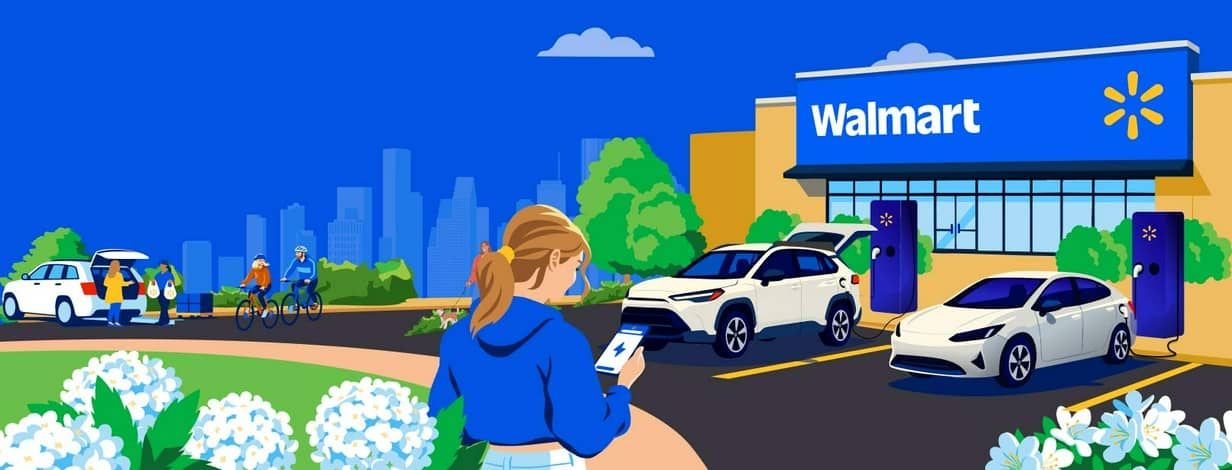
New EV chargers are arriving at Walmart stores across the country!

Fast charging
Enjoy 400 kW EV charging, compatible with CCS & NACS.

Updates on your device
Easily monitor charging status from the Walmart app.
EV charging available and coming soon:

Need an EV charger?
We've got your connection.Here's how simple it is to charge up at Walmart:

Plug in
Attach the connector to your vehicle and make sure it's fully plugged in.

Confirm your connection
Open the Walmart app, scan the QR code, choose your connector confirm & pay.

Charge while you shop
We'll let you know when your vehicle is done!
How to charge at Walmart
Walmart+
Troubleshoot your charging session
EV charging education
About EV - Walmart.com
Charging your electric car at Walmart is straightforward when you look at our high-speed network, connector options, and convenient store locations. You can use this guide to match your vehicle, your route, and your shopping time with practical charging options right at your local Walmart.
If you’re planning daily commuting or longer road trips, integrating your charging routine with a retail store stop saves you time. You’ll find clear information below on Walmart’s high-power stations, compatible connector formats (including Tesla-style NACS), and how to easily pay using your Walmart app.
Where is the closest EV charging station?
When you need to know where the closest eve charging station is, starting with a place you already plan to visit makes the most sense. You can easily find Walmart EV charging stations using many of the apps you already have on your phone or desktop like Google Maps, Apple Maps, and PlugShare. Walmart is rapidly expanding its own branded DC fast-charging network across the United States, positioning high-speed plugs at the stores you already rely on.
Because your trip likely includes everyday errands, using an EV charging retail store like Walmart provides a well-lit, secure parking area with immediate access to shopping, restrooms, and dining. You can efficiently charge your battery while you pick up groceries, grab household essentials, or take a quick break.
While home charging handles overnight needs and workplace points cover long shifts, Walmart stations offer a seamless public solution that blends perfectly into your normal weekly routine.
Choosing the right charging level for your stop
You should compare charging speed with the time you expect to spend inside the store. Think of charging levels as a direct match between your "dwell time" (how long you're parked) and how many miles of range you want to add.
· Level 1 & Level 2: Typically used for extended home or workplace parking, adding range slowly over several hours.
· DC Fast Charging: This is Walmart’s specialty. Our custom-built on-site stations feature ultra-high-power 400 kW DC fast chargers designed to give your vehicle a massive range boost during a standard 20-to-30-minute shopping trip.
The Walmart Advantage: You can look for Walmart DC Fast Charging when you need a quick turnaround on the road or want to top off your battery completely while running your regular errands.
Choosing the right connector type
You can confirm connector compatibility right from the Walmart app before you head out to charge. We've built our network to be accessible for most EV vehicles, featuring both CCS1 and NACS charging connectors.
· CCS1: The standard format for many non-Tesla electric vehicles. Our fast-charging dispensers feature native CCS1 cables to deliver peak power safely.
· NACS: Heavily linked with Tesla charging stations and next-generation EVs. Walmart’s owned and operated stations feature native NACS (J3400) connectors, allowing Tesla drivers and compatible vehicles to plug in directly without needing a separate adapter.
· J1772 & CHAdeMO: Standard J1772 handles slower Level 2 public charging. J1772 and CHAdeMO charging connectors are not available at Walmart EV charging stations.
Comparing network providers and Walmart EV charging
You can narrow your search faster when you look for dedicated retail network providers. While you may see various networks along major highway corridors, Walmart’s proprietary charging footprint offers a premium, integrated experience.
If you’re searching for the nearest Tesla supercharger or third-party plug, you frequently must navigate separate apps, variable pricing, and varying on-site amenities.
When you choose a Walmart-branded station, the experience is unified. You simply pull into an open stall, plug in, and use the Walmart app to scan the QR code on the screen to guide you through updating your payment information and initiating the charging session.
Choosing the right location for your routine
You should choose charging locations based on how easily they fit into your day. Public charging feels effortless when it doesn't require a separate, out-of-the-way trip.
· On-Site Retail Convenience: Choosing a retail store location means you aren't sitting idly in a dark highway rest stop or a tight parking garage.
· Amenities: At Walmart, your charging window aligns with a climate-controlled environment, thousands of daily products, clear lighting, and the Walmart app experience which lets you know once charging is complete.
Comparing charging cost and member savings
You should review charging costs and payment convenience before pulling up to a dispenser. Walmart offers a straightforward pay-per-kWh pricing structure with zero hidden session fees.
· Payment Method: Seamlessly managed via the Walmart Wallet inside the Walmart app.
· Walmart+ Benefits: Active members enjoy an exclusive 10% discount on charging sessions.
· Transparency: Real-time pricing, charging speeds, and session tracking are visible instantly on the EV charger screen and your phone screen when you use the Walmart app.
Using this guide for everyday trips and longer drives
You can use these advantages together whether you are managing a daily commute, weekend errands, or a cross-country road trip. By targeting high-power retail charging locations, you eliminate range anxiety.
When you combine NACS and CCS vehicle compatibility with the convenience of our Walmart Supercenters and Neighborhood Markets, you can answer where you can charge an electric car with total confidence. You'll spend less time guessing at broken public infrastructure and more time driving with a reliable, affordable, and retail-integrated plan powered by Walmart.