

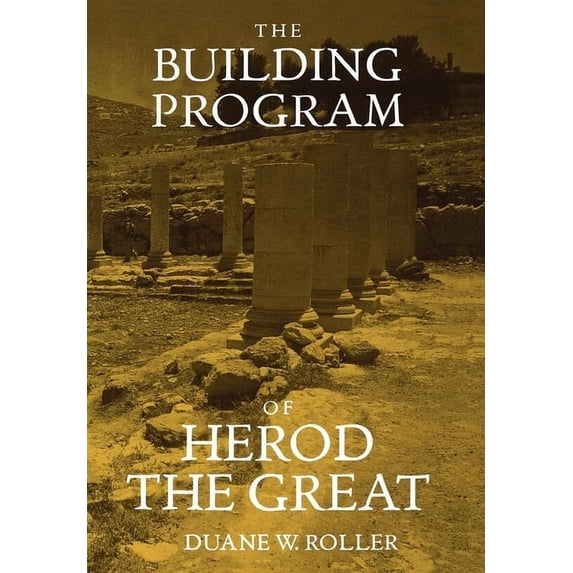
Hero image 0 of The Building Program of Herod the Great (Edition 1) (Hardcover), 0 of 1
The Building Program of Herod the Great (Edition 1) (Hardcover)
(No ratings yet)
Key item features
Herod the Great, King of Judaea from 444 B.C., is known as one of the world's great villains. This notoriety has overshadowed his actual achievements, particularly his role as a client king of Rome during Augustus's reign as emperor. An essential aspect of Herod's responsibilities as king of Judaea was his role as a builder. Remarkably innovative, he created an astonishing record of architectural achievement, not only in Judaea but also throughout Greece and the Roman east. Duane W. Roller systematically presents and discusses all the building projects known to have been initiated by Herod, and locates this material in a broad historical and cultural context.
Bringing together previously inaccessible material, Roller enriches our understanding of the enigmatic Herod and provides new insights into Roman architecture. Herod was instrumental in the diffusion of the Augustan architectural revolution into the provinces and was the first to build outside Italy such Italian architectural forms as the basilica, amphitheater, villa, and Italian temple. Herod's legacy provided a groundwork for the architectural Romanization of the east, influencing the construction of the great temple complexes and palaces so familiar from later Roman architecture.
Herod, like Augustus himself, was not only interested in architecture but also in diplomatic and financial contacts among cities of the region. In addition to providing a repertorium of the building projects, this study is also an exploration of international relations in the eastern Mediterranean at the beginning of the Roman imperial period.
Bringing together previously inaccessible material, Roller enriches our understanding of the enigmatic Herod and provides new insights into Roman architecture. Herod was instrumental in the diffusion of the Augustan architectural revolution into the provinces and was the first to build outside Italy such Italian architectural forms as the basilica, amphitheater, villa, and Italian temple. Herod's legacy provided a groundwork for the architectural Romanization of the east, influencing the construction of the great temple complexes and palaces so familiar from later Roman architecture.
Herod, like Augustus himself, was not only interested in architecture but also in diplomatic and financial contacts among cities of the region. In addition to providing a repertorium of the building projects, this study is also an exploration of international relations in the eastern Mediterranean at the beginning of the Roman imperial period.
Specs
- Book formatHardcover
- Fiction/nonfictionNon-Fiction
- GenreHistory
- Publication dateFebruary, 1998
- Pages370
- Reading levelScholarly & Professional
Current price is USD$82.01
Price when purchased online
- Free shipping
 Free 30-day returns
How do you want your item?
Try 30 days for just $1! Choose a plan at checkout.
Ships to
Arrives by Fri, May 29
|
Sold and shipped by thebookpros
4.459222380275012 stars out of 5, based on 4218 seller reviews(4.5)4218 seller reviews

Free 30-day returns
More seller options (5)
Starting from $82.01

Try 30 days of Walmart+ for just $1!
T&C apply. Claim offer now
About this item
Product details
Herod the Great, King of Judaea from 444 B.C., is known as one of the world's great villains. This notoriety has overshadowed his actual achievements, particularly his role as a client king of Rome during Augustus's reign as emperor. An essential aspect of Herod's responsibilities as king of Judaea was his role as a builder. Remarkably innovative, he created an astonishing record of architectural achievement, not only in Judaea but also throughout Greece and the Roman east. Duane W. Roller systematically presents and discusses all the building projects known to have been initiated by Herod, and locates this material in a broad historical and cultural context.
Bringing together previously inaccessible material, Roller enriches our understanding of the enigmatic Herod and provides new insights into Roman architecture. Herod was instrumental in the diffusion of the Augustan architectural revolution into the provinces and was the first to build outside Italy such Italian architectural forms as the basilica, amphitheater, villa, and Italian temple. Herod's legacy provided a groundwork for the architectural Romanization of the east, influencing the construction of the great temple complexes and palaces so familiar from later Roman architecture.
Herod, like Augustus himself, was not only interested in architecture but also in diplomatic and financial contacts among cities of the region. In addition to providing a repertorium of the building projects, this study is also an exploration of international relations in the eastern Mediterranean at the beginning of the Roman imperial period.
Bringing together previously inaccessible material, Roller enriches our understanding of the enigmatic Herod and provides new insights into Roman architecture. Herod was instrumental in the diffusion of the Augustan architectural revolution into the provinces and was the first to build outside Italy such Italian architectural forms as the basilica, amphitheater, villa, and Italian temple. Herod's legacy provided a groundwork for the architectural Romanization of the east, influencing the construction of the great temple complexes and palaces so familiar from later Roman architecture.
Herod, like Augustus himself, was not only interested in architecture but also in diplomatic and financial contacts among cities of the region. In addition to providing a repertorium of the building projects, this study is also an exploration of international relations in the eastern Mediterranean at the beginning of the Roman imperial period.
Herod the Great, King of Judaea from 444 B.C., is known as one of the world's great villains. This notoriety has overshadowed his actual achievements, particularly his role as a client king of Rome during Augustus's reign as emperor. An essential aspect of Herod's responsibilities as king of Judaea was his role as a builder. Remarkably innovative, he created an astonishing record of architectural achievement, not only in Judaea but also throughout Greece and the Roman east. Duane W. Roller systematically presents and discusses all the building projects known to have been initiated by Herod, and locates this material in a broad historical and cultural context.
Bringing together previously inaccessible material, Roller enriches our understanding of the enigmatic Herod and provides new insights into Roman architecture. Herod was instrumental in the diffusion of the Augustan architectural revolution into the provinces and was the first to build outside Italy such Italian architectural forms as the basilica, amphitheater, villa, and Italian temple. Herod's legacy provided a groundwork for the architectural Romanization of the east, influencing the construction of the great temple complexes and palaces so familiar from later Roman architecture.
Herod, like Augustus himself, was not only interested in architecture but also in diplomatic and financial contacts among cities of the region. In addition to providing a repertorium of the building projects, this study is also an exploration of international relations in the eastern Mediterranean at the beginning of the Roman imperial period.
Bringing together previously inaccessible material, Roller enriches our understanding of the enigmatic Herod and provides new insights into Roman architecture. Herod was instrumental in the diffusion of the Augustan architectural revolution into the provinces and was the first to build outside Italy such Italian architectural forms as the basilica, amphitheater, villa, and Italian temple. Herod's legacy provided a groundwork for the architectural Romanization of the east, influencing the construction of the great temple complexes and palaces so familiar from later Roman architecture.
Herod, like Augustus himself, was not only interested in architecture but also in diplomatic and financial contacts among cities of the region. In addition to providing a repertorium of the building projects, this study is also an exploration of international relations in the eastern Mediterranean at the beginning of the Roman imperial period.
info:
We aim to show you accurate product information. Manufacturers, suppliers and others provide what you see here, and we have not verified it.
Specifications
Book format
Hardcover
Fiction/nonfiction
Non-Fiction
Genre
History
Publication date
February, 1998
Warranty
Warranty information
Please be aware that the warranty terms on items offered for sale by third party Marketplace sellers may differ from those displayed in this section (if any). To confirm warranty terms on an item offered for sale by a third party Marketplace seller, please use the 'Contact seller' feature on the third party Marketplace seller's information page and request the item's warranty terms prior to purchase.
Similar items you might like
Based on what customers bought
Lessons from a Lost Republic: What Ancient Rome Can Teach Us about This American Moment, (Hardcover) $26.00
 $2600current price $26.00
Lessons from a Lost Republic: What Ancient Rome Can Teach Us about This American Moment, (Hardcover)
Artificial Intelligence in Greek and Roman Epic, (Paperback) $37.97
 $3797current price $37.97
Artificial Intelligence in Greek and Roman Epic, (Paperback)
C. Suetoni Tranquilli: Divus Augustus, (Paperback) $45.00
 $4500current price $45.00
C. Suetoni Tranquilli: Divus Augustus, (Paperback)
Eustathii Commentarii AD Homeri Iliadem, (Paperback) $74.40
 $7440current price $74.40
Eustathii Commentarii AD Homeri Iliadem, (Paperback)
Nisaba Ancient Egyptian Magical Texts, Book 9, (Paperback) $66.39
 $6639current price $66.39
Nisaba Ancient Egyptian Magical Texts, Book 9, (Paperback)
Servii Grammatici Qui Feruntur in Vergilii Carmina Commentarii, (Paperback) $66.00
 $6600current price $66.00
Servii Grammatici Qui Feruntur in Vergilii Carmina Commentarii, (Paperback)
Plutarch's "Lives", (Paperback) $26.95
 $2695current price $26.95
Plutarch's "Lives", (Paperback)
Women Creating Classics: A Retrospective, (Hardcover) $100.00
 $10000current price $100.00
Women Creating Classics: A Retrospective, (Hardcover)
The Ancient's Book of Magic, (Paperback) $23.48
 $2348current price $23.48
The Ancient's Book of Magic, (Paperback)
T. Macci Plauti Comoediae - Volume 1 Paperback $74.16
 $7416current price $74.16
T. Macci Plauti Comoediae - Volume 1 Paperback
Ab Urbe Condita (Hardcover) $49.11
 $4911current price $49.11
Ab Urbe Condita (Hardcover)
Griechische Dramen Hippolytos, (Hardcover) $50.75 Was $57.45
 $5075current price $50.75, Was $57.45$57.45
Griechische Dramen Hippolytos, (Hardcover)
Latin Literature (Hardcover) $33.95
 $3395current price $33.95
Latin Literature (Hardcover)
Bibliotheca Scriptorum Graecorum Et Roma Satyricon reliquiae, (Paperback) $48.47
 $4847current price $48.47
Bibliotheca Scriptorum Graecorum Et Roma Satyricon reliquiae, (Paperback)
A Historical and Topographical Guide to the Geography of Strabo, (Paperback) $58.99
 $5899current price $58.99
A Historical and Topographical Guide to the Geography of Strabo, (Paperback)
Invisible Satirist: Juvenal and Second-Century Rome, (Hardcover) $96.71
 $9671current price $96.71
Invisible Satirist: Juvenal and Second-Century Rome, (Hardcover)
Sammlung Tusculum Aeneis, (Hardcover) $51.35
 $5135current price $51.35
Sammlung Tusculum Aeneis, (Hardcover)
Perfundo - Pernumero, (Hardcover) $77.42
 $7742current price $77.42
Perfundo - Pernumero, (Hardcover)
Horace, (Hardcover) $33.95
 $3395current price $33.95
Horace, (Hardcover)

Customer ratings & reviews
0 ratings|0 reviews
This item does not have any reviews yet

Related pages
- Hitlers Occult
- Ancient Romans
- Ancient Roman History Books
- Hitler S Drugs
- Best Translation Art War
- Best Sellers In Ancient Military History
- Best Sellers In Ancient Roman History
- Civilization History Books
- General Ancient History Books
- Renaissance History Books
- General Movements in Philosophy Books
- Comparative Politics Books