

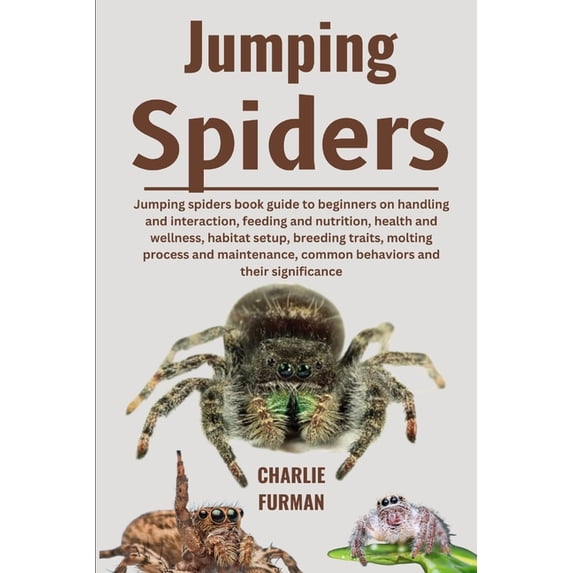
Jumping Spiders: Jumping Spiders Book Guide To Beginners On Handling And Interaction, Feeding And Nutrition, Health And , (Paperback)
(No ratings yet)
Key item features
- Jumping Spiders: Jumping Spiders Book Guide To Beginners On Handling And Interaction, Feeding And Nutrition, Health And , (Paperback)
- Author: Independently Published
- ISBN: 9798304296571
- Format: Paperback
- Publication Date: 2024-12-20
- Page Count: 106
Specs
- Book formatPaperback
- Fiction/nonfictionNon-Fiction
- GenreHome, Hobbies, & Garden
- Publication dateDecember, 2024
- Pages106
- Reading levelGeneral
Current price is USD$17.47
Price when purchased online
- Free shipping
 Free 30-day returns
How do you want your item?
Ships to
Arrives between Jun 1 - Jun 4
|
Sold and shipped by thebookpros
4.459222380275012 stars out of 5, based on 4218 seller reviews(4.5)4218 seller reviews

Free 30-day returns
About this item
Product details
A unique and intriguing group of arachnids, leaping spiders are members of the Salticidae family and are distinguished by their remarkable vision and distinctive jumping skills. They are one of the biggest and most diverse families of spiders, with over 6,000 species known to exist worldwide. These spiders' exceptional flexibility is demonstrated by the fact that they can be found in a variety of settings, including urban areas, arid deserts, and tropical rainforests. Physical attributes Typically, jumping spiders have small bodies that range in length from 1 to 25 millimeters. They can act as camouflage or a warning to predators because of their compact, sturdy body and frequent brilliant colors or patterns. Their big, forward-facing eyes are their most distinguishing characteristic. The four pairs of eyes that jumping spiders have are especially big in the anterior median pair, giving them superior binocular vision. Their ability to see well is essential to their hunting technique because it enables them to calculate distances precisely and leap on victims.
Hunting Methods and Behavior Jumping spiders don't spin webs to capture prey like many other spiders do. Rather, they hunt by using their exceptional vision and nimble movements. Like cats, they have a distinctive stalking style and are avid hunters. They approach cautiously after spotting possible prey, frequently pausing to reassess the distance before leaping forward to seize it. Their strong hind legs and internal hydraulic system, which enables them to quickly stretch their legs, enable them to jump. Intricate courtship dances are another characteristic of jumping spiders. To entice females, male spiders put on complex displays that combine motions, vibrations, and visual cues. In order to ensure that the males attract the right species and communicate their fitness to the females, these species-specific displays are essential to successful mating. Distribution and Habitat Because of their remarkable adaptability, jumping spiders may flourish in a variety of settings. With the exception of Antarctica, they may be found on every continent, where they live in a variety of environments, including deserts, grasslands, woods, and human settlements. Although they mostly eat insects and other small arthropods, certain species have been seen to consume nectar and plant materials, demonstrating how adaptable they are in terms of their diet. Jumping spiders are frequently seen in parks, gardens, and even residences in metropolitan areas. By feeding on insects like flies and mosquitoes, they help manage pest populations. Cognitive and Visual Abilities Among all arthropods, jumping spiders have some of the best vision. Some species can even perceive ultraviolet light, and their primary eyes can pick up on subtle hues and features. Their ability to see well is crucial to their existence and enhances their hunting skills. According to recent research, jumping spiders display a level of cognitive sophistication uncommon for invertebrates. They are able to recall where they are, plan paths to their prey, and even solve problems. According to these cognitive capacities, jumping spiders are more intelligent than previously imagined. The significance of ecosystems
The preservation of ecological equilibrium is greatly aided by jumping spiders. As predators, they aid in managing pests by regulating the numbers of insects and other tiny arthropods. They are also useful indicators of the health of the environment because they can be found in a variety of settings. An amazing collection of arachnids, jumping spiders are distinguished by their keen vision, dexterous hunting strategies, and complex behaviors. Both scientists and sp
Hunting Methods and Behavior Jumping spiders don't spin webs to capture prey like many other spiders do. Rather, they hunt by using their exceptional vision and nimble movements. Like cats, they have a distinctive stalking style and are avid hunters. They approach cautiously after spotting possible prey, frequently pausing to reassess the distance before leaping forward to seize it. Their strong hind legs and internal hydraulic system, which enables them to quickly stretch their legs, enable them to jump. Intricate courtship dances are another characteristic of jumping spiders. To entice females, male spiders put on complex displays that combine motions, vibrations, and visual cues. In order to ensure that the males attract the right species and communicate their fitness to the females, these species-specific displays are essential to successful mating. Distribution and Habitat Because of their remarkable adaptability, jumping spiders may flourish in a variety of settings. With the exception of Antarctica, they may be found on every continent, where they live in a variety of environments, including deserts, grasslands, woods, and human settlements. Although they mostly eat insects and other small arthropods, certain species have been seen to consume nectar and plant materials, demonstrating how adaptable they are in terms of their diet. Jumping spiders are frequently seen in parks, gardens, and even residences in metropolitan areas. By feeding on insects like flies and mosquitoes, they help manage pest populations. Cognitive and Visual Abilities Among all arthropods, jumping spiders have some of the best vision. Some species can even perceive ultraviolet light, and their primary eyes can pick up on subtle hues and features. Their ability to see well is crucial to their existence and enhances their hunting skills. According to recent research, jumping spiders display a level of cognitive sophistication uncommon for invertebrates. They are able to recall where they are, plan paths to their prey, and even solve problems. According to these cognitive capacities, jumping spiders are more intelligent than previously imagined. The significance of ecosystems
The preservation of ecological equilibrium is greatly aided by jumping spiders. As predators, they aid in managing pests by regulating the numbers of insects and other tiny arthropods. They are also useful indicators of the health of the environment because they can be found in a variety of settings. An amazing collection of arachnids, jumping spiders are distinguished by their keen vision, dexterous hunting strategies, and complex behaviors. Both scientists and sp
- Jumping Spiders: Jumping Spiders Book Guide To Beginners On Handling And Interaction, Feeding And Nutrition, Health And , (Paperback)
- Author: Independently Published
- ISBN: 9798304296571
- Format: Paperback
- Publication Date: 2024-12-20
- Page Count: 106
info:
We aim to show you accurate product information. Manufacturers, suppliers and others provide what you see here, and we have not verified it.
Specifications
Book format
Paperback
Fiction/nonfiction
Non-Fiction
Genre
Home, Hobbies, & Garden
Publication date
December, 2024
Warranty
Warranty information
Please be aware that the warranty terms on items offered for sale by third party Marketplace sellers may differ from those displayed in this section (if any). To confirm warranty terms on an item offered for sale by a third party Marketplace seller, please use the 'Contact seller' feature on the third party Marketplace seller's information page and request the item's warranty terms prior to purchase.
Customer ratings & reviews
0 ratings|0 reviews
This item does not have any reviews yet
